Watching elected councillors begging paid bureaucrats to actually work for the citizens is not my thing; such red tape factories are renowned for swallowing common sense whole.
But occasionally I come across a town hall which deserves accolades aplenty, not just for visionary decision-making, but indeed for the building itself. Welcome to Augsburg town hall.
I was fortunate to be in the town square at dusk on the night which marks the beginning of Christmas season. From the first floor windows of the town hall, theatre played out for the crowd, who were gathered to celebrate the opening of the Christmas markets, despite the rain. It was difficult to tell if the enthusiastic applause was simply to congratulate the actors, or relief that the main event was inching closer. Tantalising smells wafted through the square. From behind the stalls shutters came the noisy promises of food being prepared. Politeness subdued impatience as the Mayor delivered their obligatory speech, though I could feel expectations building as folk jostled for the best vantage point. Suddenly, hundreds of sparkly lights fired up the towering central Christmas tree, a spontaneous cheer rang out, and the stalls lifted their shutters; Christmas season had officially begun.
Those in the know rushed to their favorite stalls, intent on getting their mulled apple, hot meat bun, or first choice of whatever handcrafted gift they desired. There was no chance to wander aimlessly; the night was urgent and euros flew.
We headed away for warm drinks, board games and laughter in the relative peace of my hosts home; there would be time to visit the Christmas market another day.
And visit we do. Row after row of temporary alleyways lined with glitter, tradition and consumerism. Smells intice you to try a myriad of German fare; foods I don’t even know the name of. It would be sacrilegious to refer to the still-cooking spiced meat presented in metre-long skins simply as sausages, or the deeply-rich baked items as bread or biscuits. Does chocolate presented as overcoats on mouth-sized pieces of fruit count as food? And what about the dozens of boiled sweets, with flavors so embedded it’s enough just to hold the sweet to your nose and inhale? Oh to have the stamina to try one of everything!
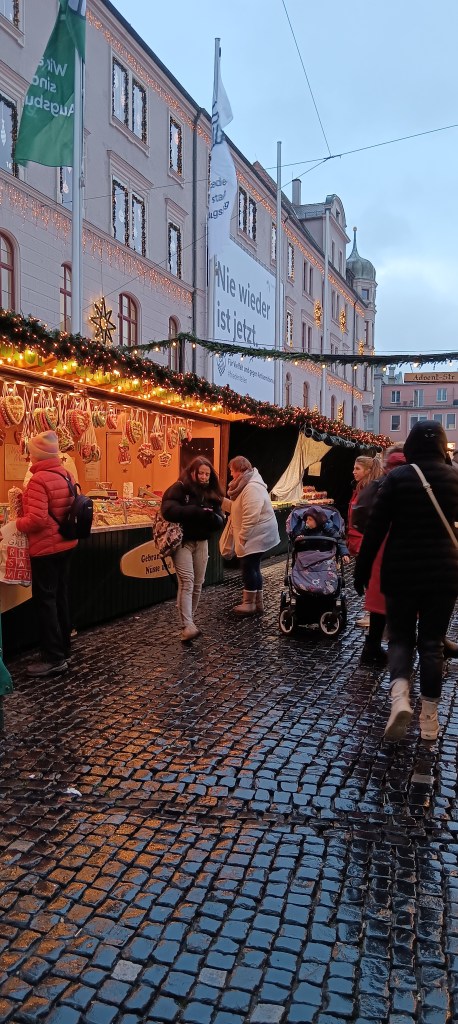

An older gent selling cards tips his hat to me; his waistcoated black and white attire cannot conceal that he could, in fact, be Father Christmas. It was the twinkle in his smile which brought me back to buy a card after all.
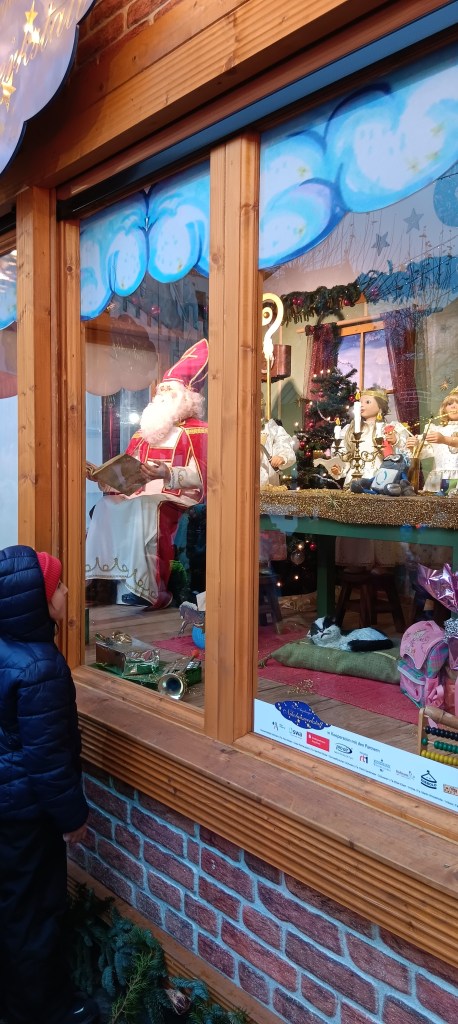
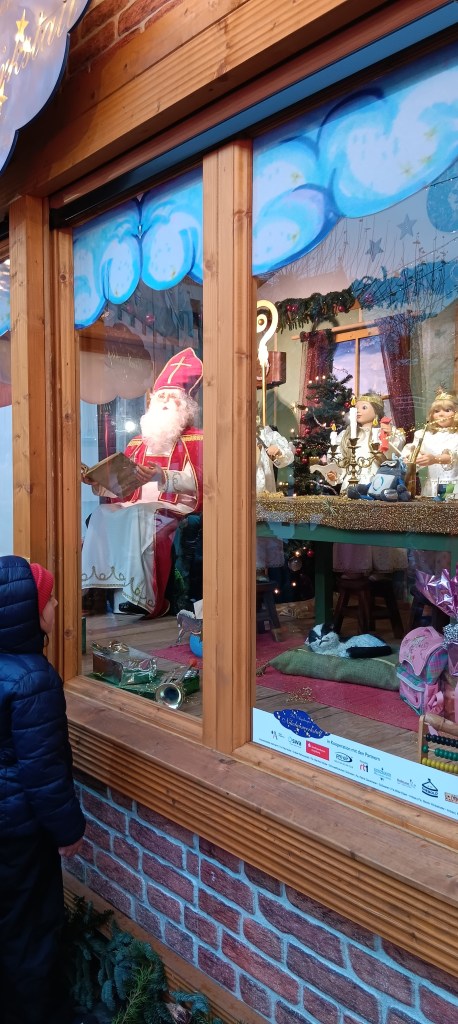
Around a corner, an area just for kids! A merry-go-round, model santa reading stories (how he and his angels move remains a mystery), and lo! A proper Punch and Judy show, finally fulfilling a long-held childhood wish. It’s not just kids who get caught up in the action.

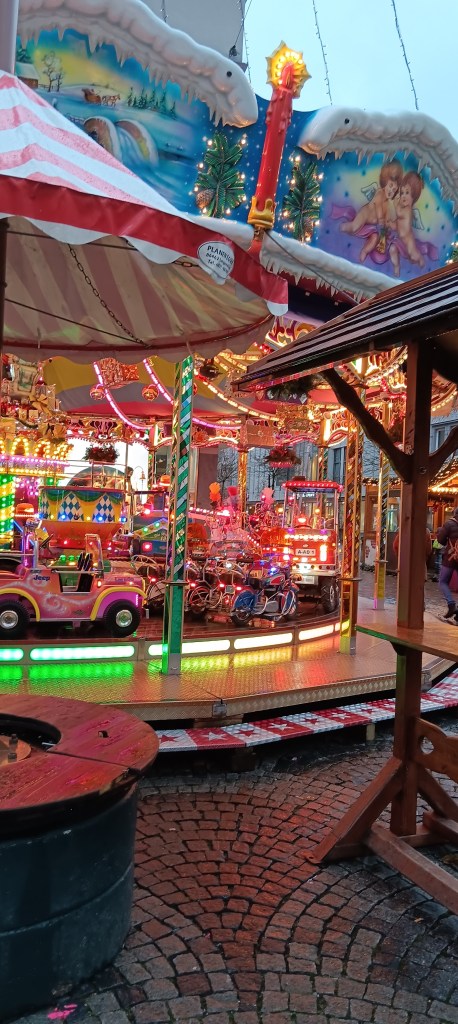
Crowds swirl in a river of Christmas-shopping desire. Socks, hats, decorations, jewelry, candles… it is all here. Wooden carved deer peer at the chinese-made trinkets next door, while real leatherware hangs silently across the row. With so many beautifully handcrafted offerings, I wondered who had allowed the mass-produced junk in? For plastic landfill materials there were; cheap stocking fillers as can be found in most western-world markets nowadays. Imagine if we refused to buy them. The manufacturers would surely find something more sustainable, or at least recyclable to create; we are our own worst enemies.
What isn’t man-made is the snow gently wafting down. In my home area snow arrives unexpectedly during ferocious storms, when the world temporarily quietens as though taking a breath, until fiercely reinvigorated rain takes over, pummeling down, seeking to turn the ground into slush.
Augsburg’s snow was a completely different beast. As we wandered the markets, snow began falling quietly all around us, adding fairytale magic to the sparkling Christmas decor.
Eventually the cold drove us away from the stalls; stepping into the Town hall for certain warmth. Incongruous in such an historic building, central spot housed a robotic scene, where the figures told a story through almost poetic movement. Intellectually I knew someone had built this thing; it was just man-made automation, but the part of me that believes the tooth fairy should visit adults too was easily convinced that this enactment, and the boy within, was real.
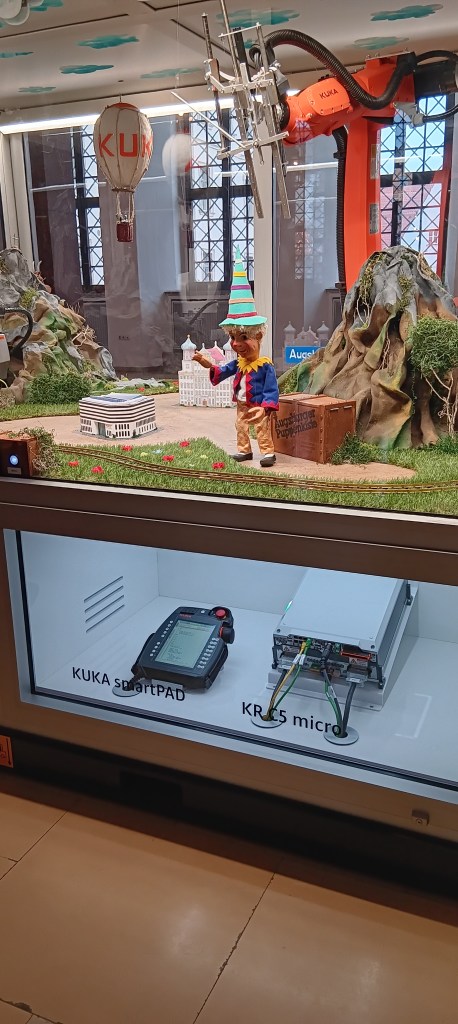
An alcone nearby displayed relics from Augsburg’s past. The closeness of the two displays sharply reminding me how far technology has developed. Yet there is an underlying commentary here, with gentle hints of conflict. Despite centuries of ‘civilization’ humans have not been able to ensure new ideas are only used for good. What is it about man that we must turn the gift of new learnings into negative forces? Is Newtons third law of motion at work here; each action has an equal and opposite reaction? Surely not.
Moving on from the object displays, I learn that this Renaissance-style building, from the 1620’s, was almost destroyed during World War Two. Photos show nothing short of devastation. No murals or treasures remained intact. Dreams lay in rubble. And yet here we are, in a building supposedly protected by the Hague Convention from further damage during times of conflict. Can a few signatures on a piece of paper located elsewhere really protect anything?
Climbing up to the second floor, I wonder what would entice a city to rebuild a replica such as this. The heavy wooden stairs certainly give no hint of modernisation. What could be so special about the original building that the 1980’s would see a vast amount of money spent on putting things back as they were?
But then, the doors open, and I gasp. Der Goldener Saal defies belief. To call it the Golden Room in no way substantiates it’s glory. Such murals, and overwhelming gold. I wander about, neck bent back, oblivious to others as my brain tries to absorb the intricacies of such craftsmanship. (For scale, spot the woman in the third photo).
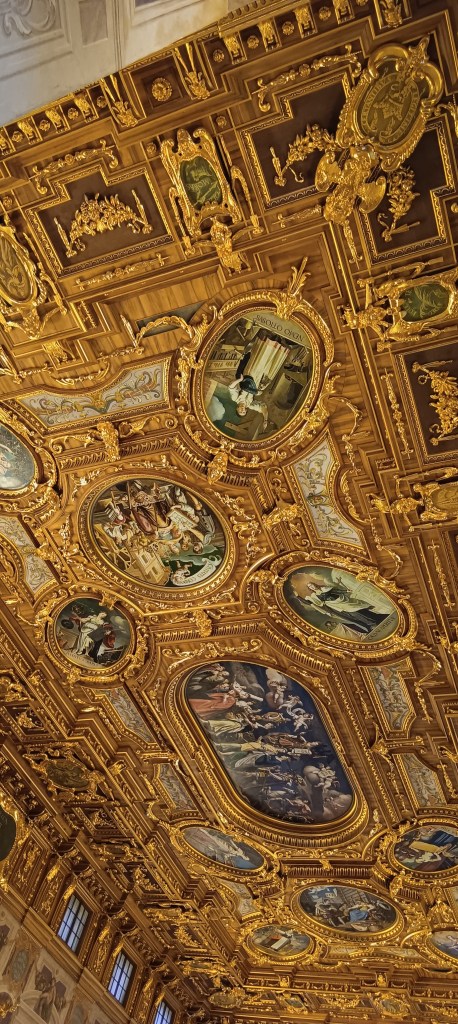
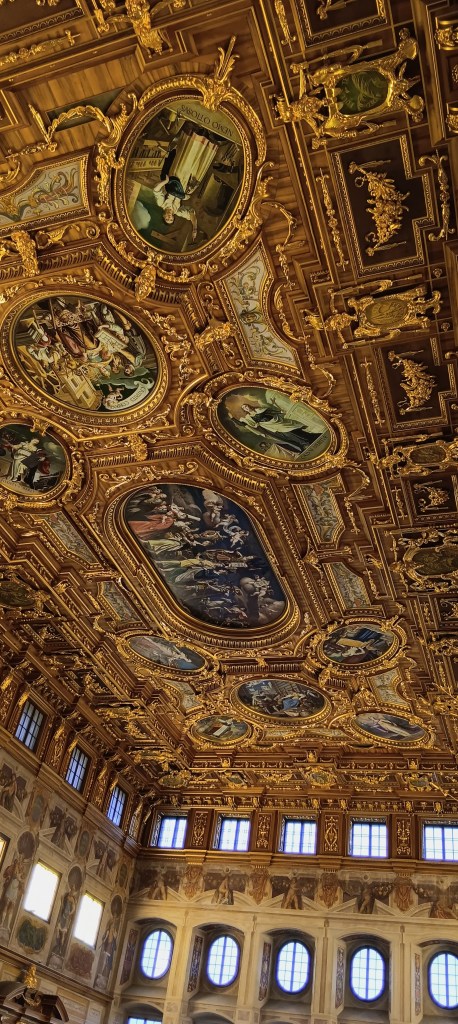
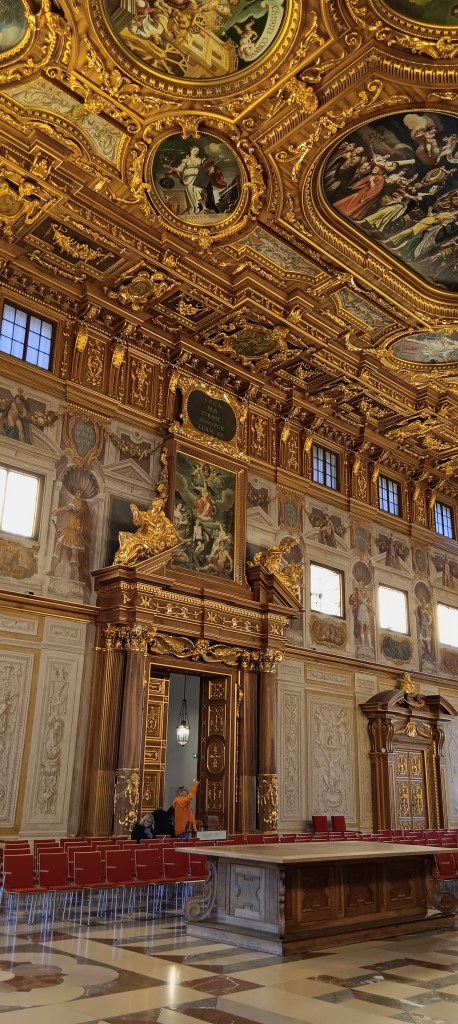
Taking a breather, I take a moment to enjoy the view outside; the Christmas markets are bustling.

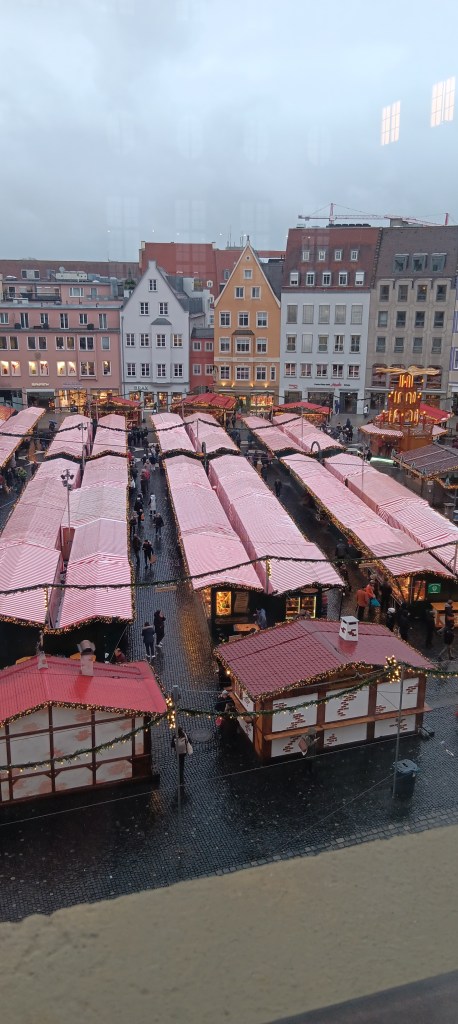
But my eyes focus cannot resist the draw of the murals overhead. Each scene takes time to appreciate.
In contrast, the adjoining Princes rooms, where special guests of council could retreat, are intricately simple, with wood as the mainstay. Here the walls are lined with portraits, refreshingly not all men, but there are no stories attached, so I learn nothing. In the corner, a fabulously-crafted heating unit, whose hungry belly would have had to have been kept stoked by some poor servant, whilst overhead each Princes room was blessed with symmetrical ceiling craft in stained wood.
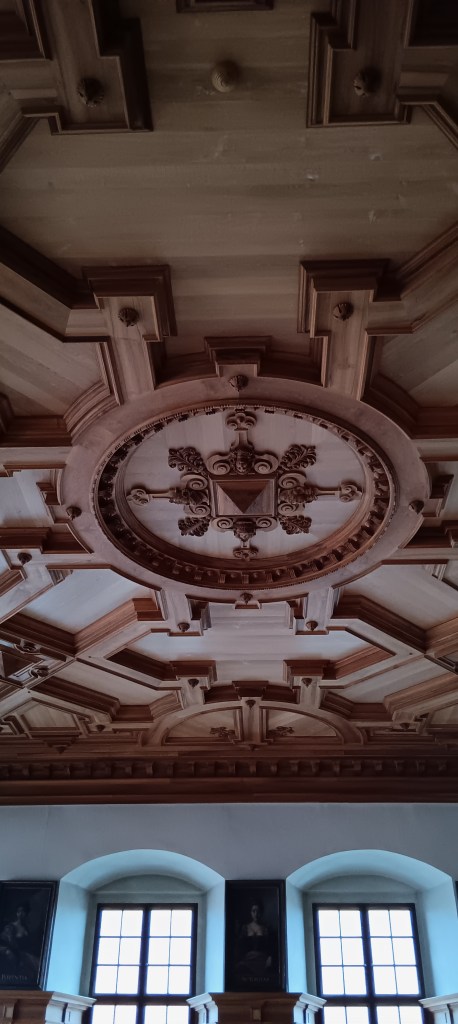
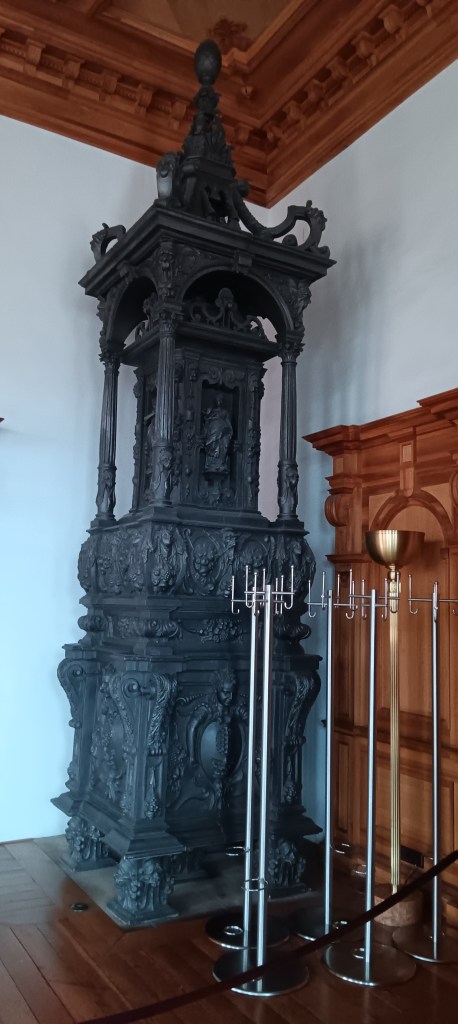
Back in the feature room, my host tells me he visited this very space to be awarded recognition of sporting achievement whilst he was still at school. Each year young residents are honored by the city, in a special ceremony; I can only imagine the pride, and nerves, of the recipients.
And that’s what this building is all about. Not the tragedy that the rebuild cost more than food banks need to feed the hungry, nor that the original was lost in wartime, but in a towns sense of belonging. Augsburg’s decision-makers recognized the need for civic pride, a non-denominational place that residents can enjoy and be empowered by. Just as Aotearoa New Zealand’s Christchurch is rebuilding their cathedral after the devastating 2011 earthquakes, and people everywhere rebuild after fire, flood, or tornado, Augsburg has chosen to acknowledge it’s heritage, moving forward in a way which brings it to life for citizens and visitors alike. Every community needs links to the long-ago. For Augsburg, the rebuild itself has become part of the story.
Would I visit every civic building? Heck no! But Augsburg Town Hall? Wow!
 Stories for you - Enjoy!