Braunschweig; what a place!


But first, getting there can be quite an adventure. Heathrow’s Terminal Five requires a bit of stamina. Arriving early is no guarantee of making the flight. First get your boarding pass from kiosk one, then drop your bag at kiosk two. No problems there.
Securities next. Jacket, pocket contents, belt, backpack, shoes and polarfleece into trays please madam. Also phone, money, passport. Don’t forget to place the tablet/laptop in a separate tray. Step this way madam. Stand on the yellow feet drawings, arms high above your head.
Alarm sounds; I’d told them it would. Step this way madam. A female officer pats me down, and seems disappointed not to find any concealed weapons. Clearly I fit the profile.
Getting dressed and repacking my gear seems to take ages, but only because I’m being watched.
Down the escalator to an enormous shopping precinct. Do people really spend forty thousand pounds on a watch while they’re waiting to catch a plane?

I bought a cup of tea.
One hour before my flight, the departures board advises which gate to go to, and to do it now. This terminal has sixty-six gates (!) seperated into zones A, B and C. I headed straight down, or I would have if the lift didn’t have a lengthy queue. There is no stairs option. The only comfort is that airline staff are also caught up in the wait. Eventually I manage to squeeze in with a dozen strangers who are temporarily way too familiar. At the bottom we walk about ten minutes to an underground tube. A train to get us to our plane! Then up two sets of escalators, another security check, down an escalator, then through a tunnel and finally onto the plane!
Taking off from Heathrow at night gives the most splendid views of London. A startlingly beautiful red and white ribbon winds it’s way north. Fitting for Christmas time, but it’s actually the brake lights of traffic-jammed northbound commuters alongside the headlights of southbound users. Extraordinary from the air.
Arriving in Hanover, the border control wanted to know why I was visiting Germany? So tempting to ask him if he knew a reason why I shouldn’t, but one must not joke with uniforms who could ruin your holiday. But then there’s the sheer joy of a hug with a friend I’ve not seen in over five years. The addition of her boyfriend was a lovely surprise.
Embarrassingly, I went to get into the wrong side of the car, completely forgetting Germany is left-hand drive.
We’re in Germany, so naturally we went to a Turkish restaurant hidden away in a dark carpark down by the river. Flavors fingered their delicious odours through the music-based atmosphere, tapestries rugs hung from the ceiling as though ready for flight, and soft eastern lighting warmed the eyes. The decor included etched urns resting comfortably, like well-satisfied gourds. Eating areas were separated by clever use of changing floor heights, screens and short walls. Yet all of us could see the enormous earthen oven from which came succulent lamb, delicious breads, and more. The food was so tasty, I dare not try another Turkish restaurant for fear of being disappointed.
Thoroughly replete, we headed away from Hanover. How well the autobahn works. There I was, sitting on the wrong side of the car, on the wrong side of the road, gliding effortlessly along at one hundred and sixty kilometers an hour! Wonderful.
Autobahn rules are simple. Only enter the fastest lane for overtaking, then slip back into a slower lane until you need to pass again. It’s seamless despite the huge variation in speeds. More than one car passed us as though we were standing still, despite our momentum⁸ú.
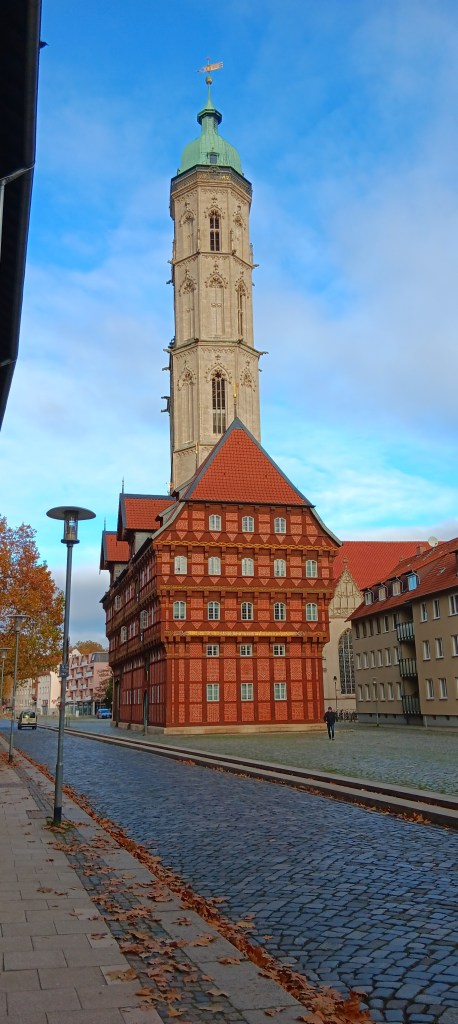
Arriving in Braunschweig is such a pleasure. The city took the opportunity presented from being heavily bombed in WW2 to rebuild with care. The sense of space, especially when looking out apartment windows, is to be treasured.

Some old areas are protected so as to preserve the architecture and atmosphere. This includes the oldest house, currently undergoing restoration.
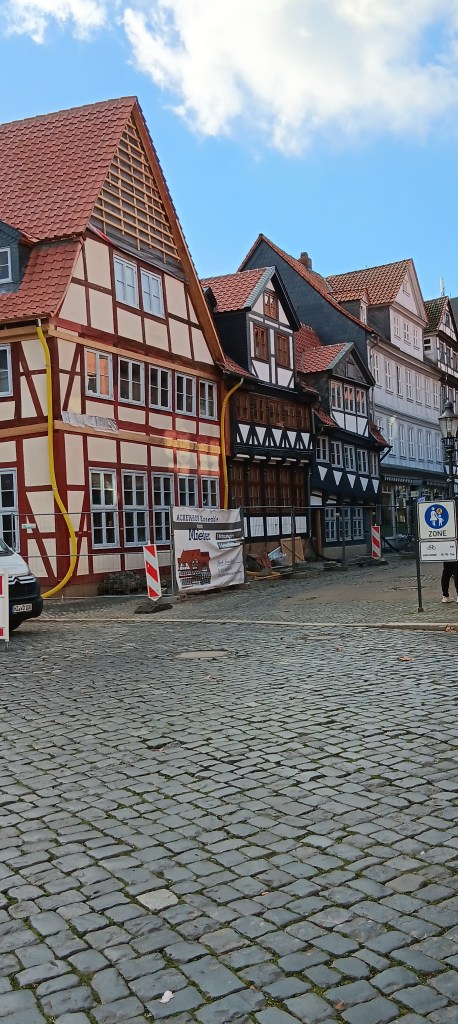
Then there’s the leaning building:

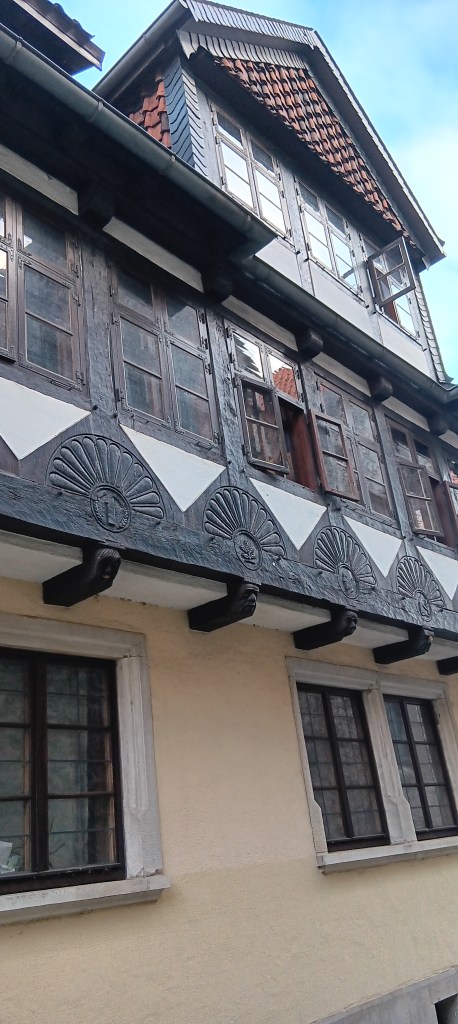
The detail on the buildings may look the same, but closer inspection shows no figure or emblem is repeated.
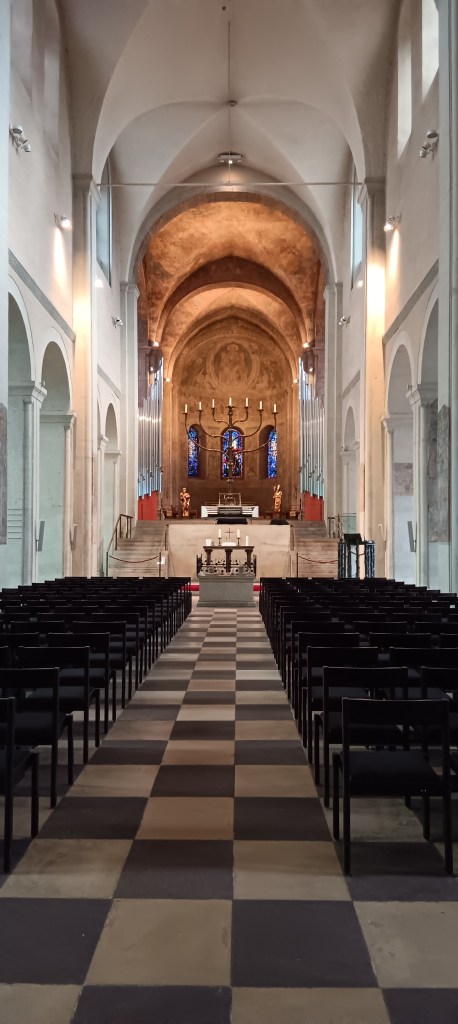
And the Magnikirche rebuilt with more modern stain glass.

The wooden ceiling is a work of art too. This same church was able to include a section of it’s predecessor.

Other churches faired better, with their murals and memorials left intact.


The Brunswick cathedral/dom (Brunswick being the anglosized name for Braunschweig) has in it’s depths, the crypt of centuries-old caskets holding the likes of Otto iv (Roman emporer to 1218), Caroline of Brunswick (Queen consort of UK’s George iv), and, in a seperate deeper down stone crypt, Henry the Lion and Matilda of England.

The latter two lie in state within stone slabbed tombs, directly under the cathedral stage, in cold barren isolation. Ironically, the visitor must pay a euro to descend into these depths. Once down there, I would have paid more to leave. Having said that, note the carving on the beautiful wooden coffins in the first area. They all have a version of Christ on the cross at the head of the lid also. I was pleased we were not able to touch them. Whilst admiring the workmanship, there was still a spooked feeling of not belonging down there.
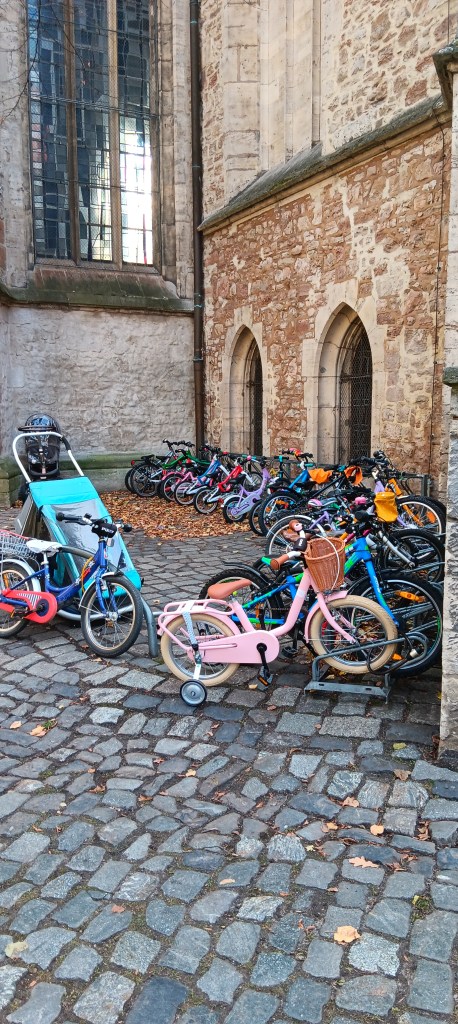
Outside, tucked into a corner of the church, a kids carpark for the kindergarten… or rather, a bike park. No-one drives their offspring to this preschool.
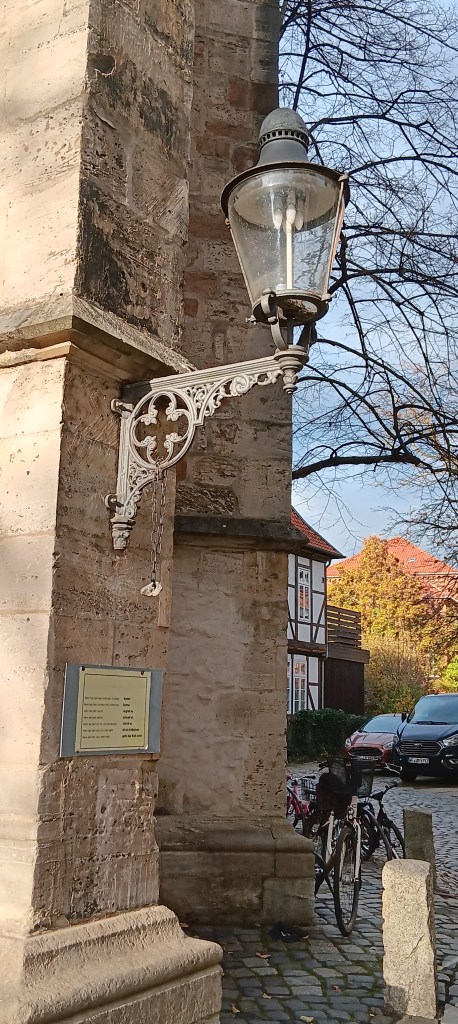
Hanging just around the corner, a stone. The sign says if you can’t see the stone, it’s foggy. If there’s a shadow from the stone, it’s sunny. If it’s wet, rain. White means snow. If it’s moving left and right, windy. Up and down means earthquake. And if the stone is going upwards, the world’s going under and we’re all in trouble!
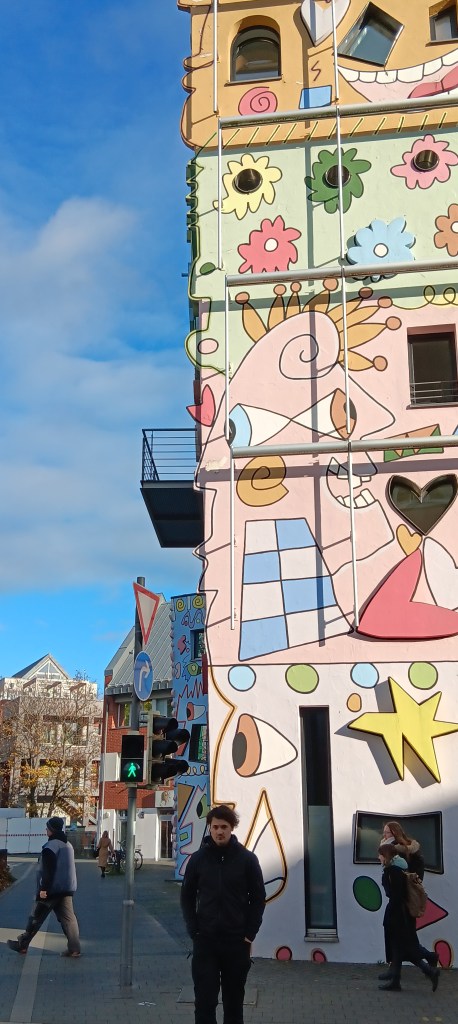
Amongst all the traditionally-based architecture, a folly; the Happy Rizzi House, built for a company. It certainly brings a smile. Note how some of the pictures extend past where the walls should end.

Sundays are special in Braunschweig, as for many areas I visited in Germany. Most stores are shut, and residents are not allowed to make noise on Sunday mornings. No mowing lawns!
More seriously, note the Stumbling stones in some streets. These are raised slightly, to ensure the passerby takes note.
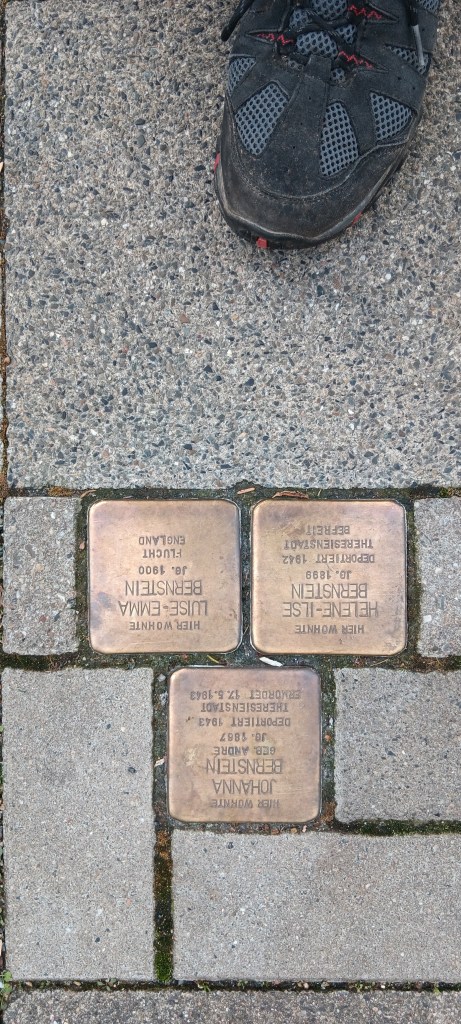
Placed there as part of the Stolpersteine project by artist Gunter Demnig, these brass plaques remember persons murdered or persecuted by Nazis. They are set into the sidewalk outside the last known self-determined residence of the person. There are over 390 in Braunschweig. The three photographed remember
– Johanna Bernstein, nee Andre, b1867, who was murdered in the Theresienstadt ghetto 17 May 1943. Theresienstadt was a waystation for sending people to extermination or forced-labour camps.
– Helen-Ilse Bernstein b1899, sent to Theresienstadt 1942, and was liberated (end of war?)
– Luise-Emma Bernstein b1900, fled to England
If you look up the project on Wikipedia, there is a list of all the stones, with maps. It makes very sobering reading.
What impressed me about the stones, apart from the horror behind them, was how they keep the memory of each person in the current population’s consciousness. Just stopping to read the plaques outside the address they had lived brought those three women to me as real people. Far better than reading a mass memorial wall somewhere, or learning from the media.
That the city decision-makers had the foresight to approve such a project is somehow a relief, in acknowledging the past.
And on a much nicer note, back in the present day, though harking back, is the extraordinary story of the horses atop what was Brunswick castle. The building retains it’s facade, but looks are deceiving; this is a very modern shopping mall.
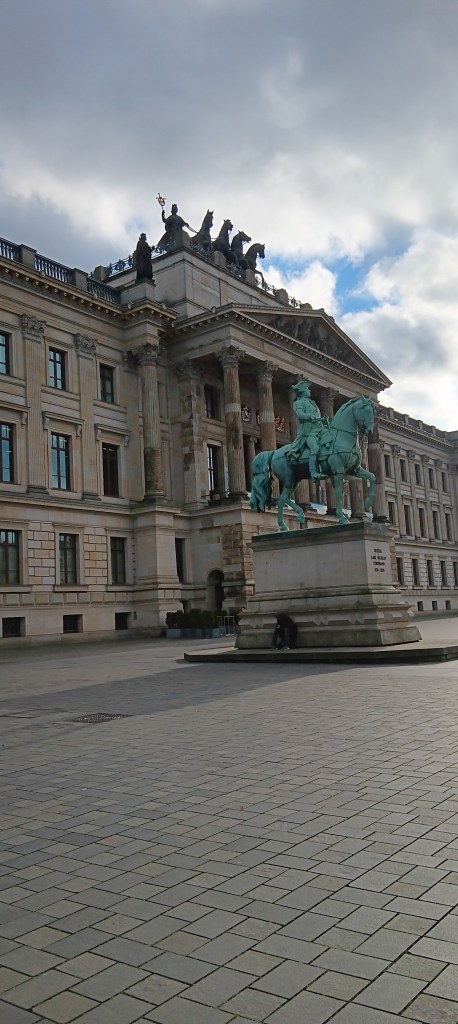
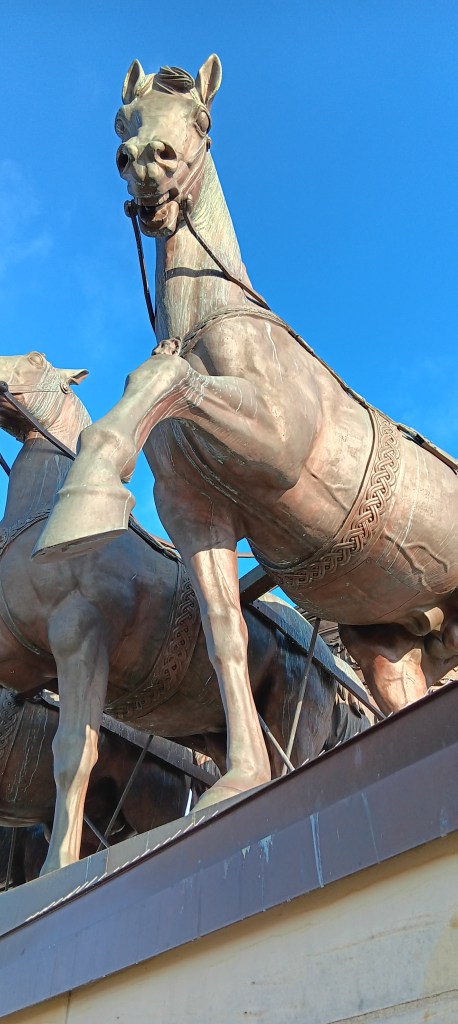
The horses above the mall are supposedly of Viktoria and her stallions. First built in 1863 by building a wood model then creating a bronze coat, they were destroyed by fire just two years later. Rebuilt, though slightly smaller, in 1868, they survived both world wars, only to have all the copper plating stolen in the 1960’s for money. Finally, in 2003, this replacement was made, taller than it’s predecessors. Getting the lift up to walk the terrace just under their feet gives a real sense of the craftsmanship involved; they even show the veins of a horse in hot work.
Another eye opener, involving craftsmanship of a different kind, was the visit to the supermarket, which revealed vast arrays of cheeses, breads and sausages, along with more unusual advent calendars…

Yes, it really is an advent calendar with twenty four varieties of beer to test; one per day!
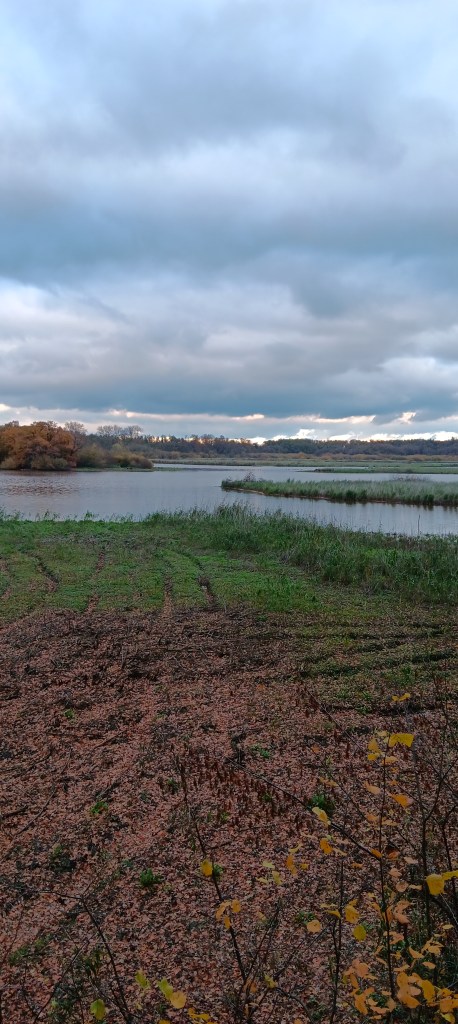
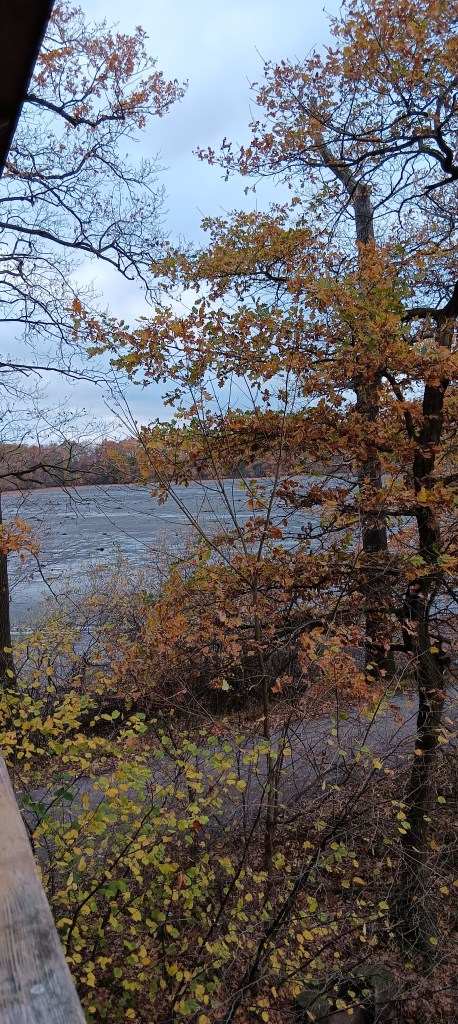
On the outskirts of town, a walk through a lake area brought us to a fishery where the practices are centuries old. One of the lakes contains no water, and apparently hasn’t done so for quite some time, despite situated within ten meters of it’s sister, and being very muddy, as though water still flows through. The wildlife on the lakes kept their distance, but included herons, ducks etc.
Nearby, homes tantalize with their comfortable age-old design. It’s traditional across Germany to have the buildings construction date showing prominently.

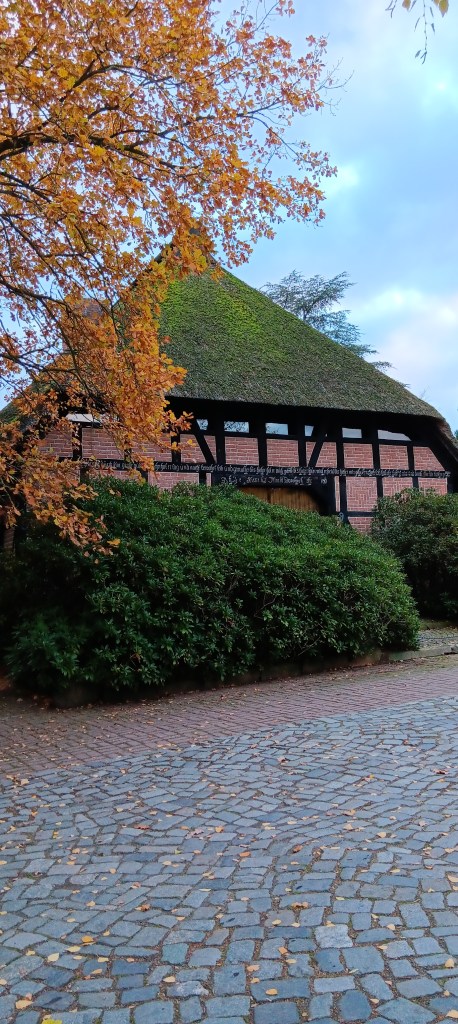

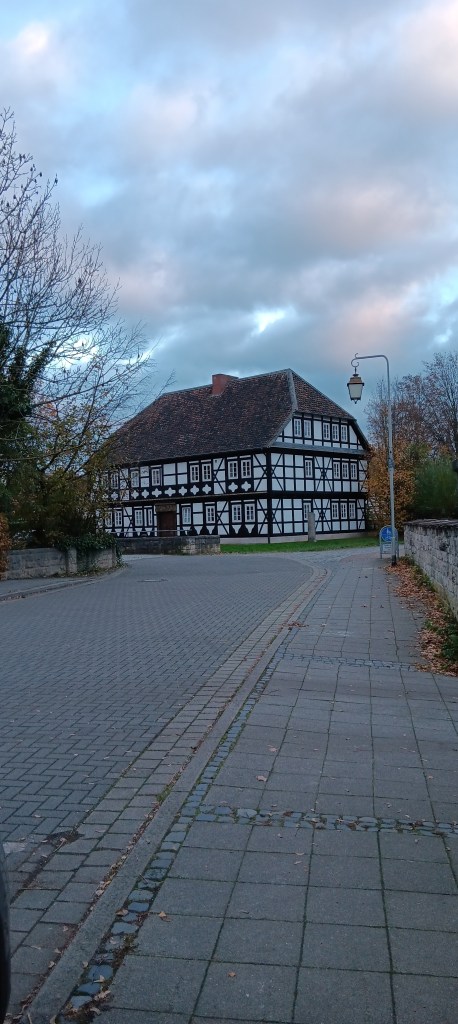
One of the great pleasures of visiting friends is how easily we slip into old patterns; after a lovely home-cooked meal in my hosts student apartment, a night of board games. I soon took to the game ‘Black dog.’ If anyone has a set…
A trip to Harz National Park revealed the sad plight of forestry and native trees alike. A bug which liked to attack fir trees followed the mass planting of fir forestry plantings into Germany, but soon realized that the native forest was delicious too. To see whole swathes of dead trees demoralizes not just locals.

Harz National Park is a hive of walking tracks and rock climbing. The track we chose wanders along the river, providing insights to the occasional building on the rivers edge. One had been burnt out; a blackened edifice of what had once been a fine building, with balconies directly above the water. Another place had been a hotel, with the dining room bridging the river completely. But there’s no beating the riverside walk.

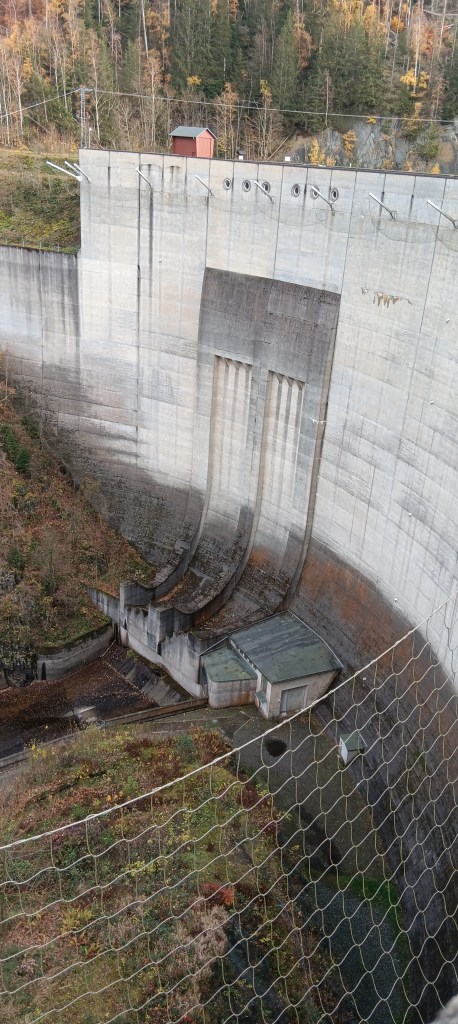
Further on, the unexpected sight of a dam built in 1956 for electricity generation as well as flood control. Sixteen homes were consumed by the dams reservoir, but it’s now a mecca for all kinds of activity, including a ferry traversing most of it’s length. The shed door at the bottom gives an idea of the day’s height.
At the carpark, a food cart entices the unwary. What is it about food carts that attracts us, even when we are already well fed? Another wee surprise; we accidently discovered a spot where there is an echo, but only if you stand in exactly the right place.
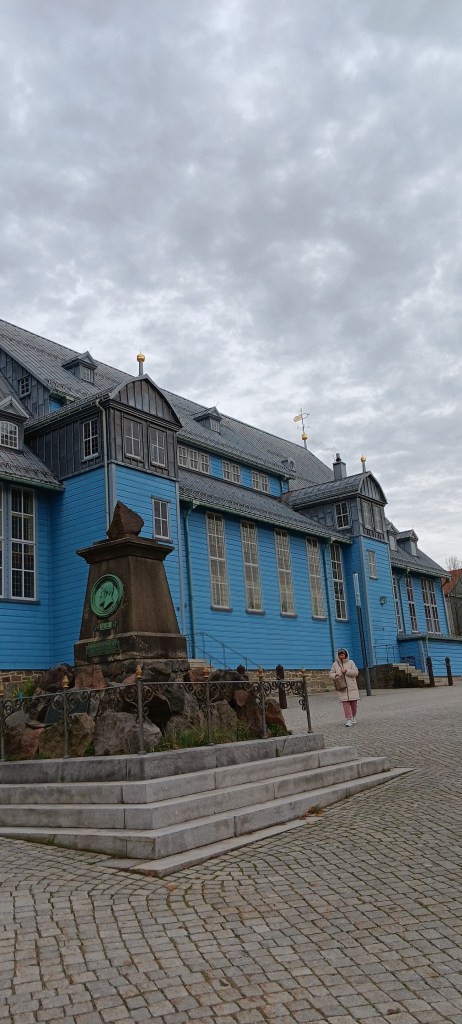
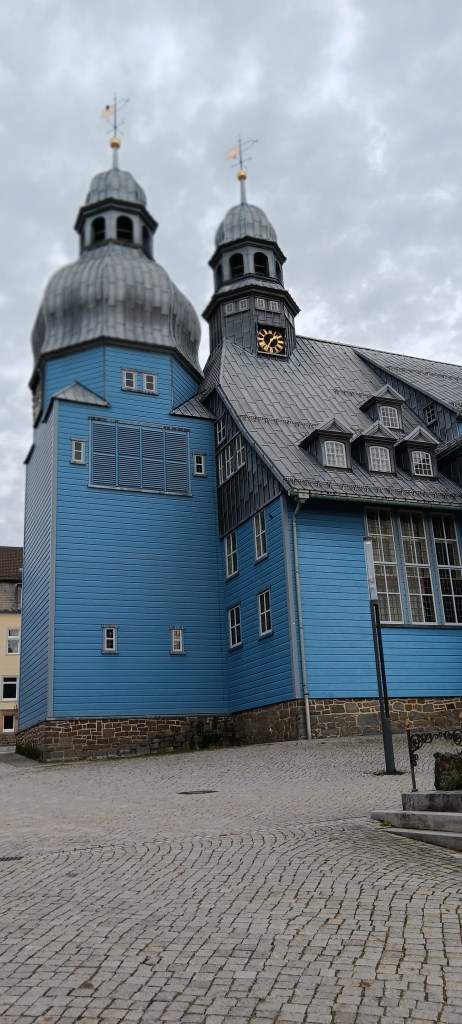
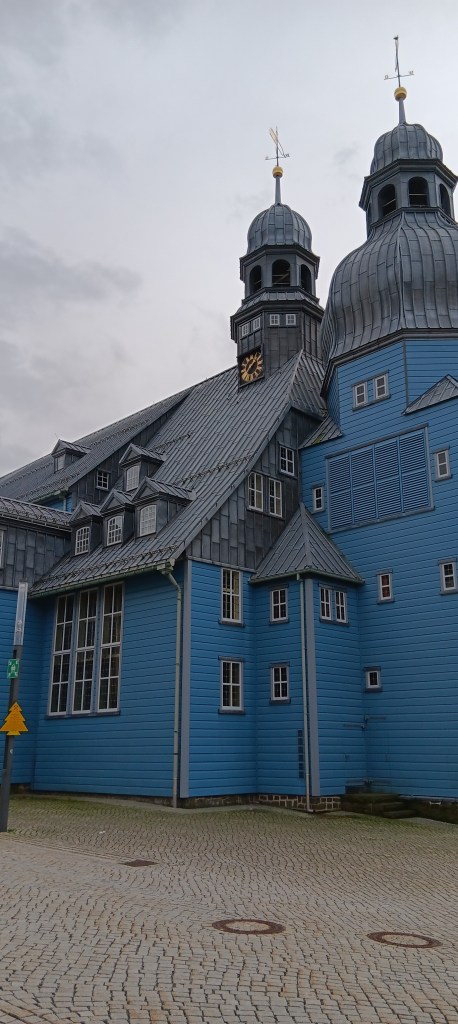
Further on, a mountain village. The buildings are magnificent, though quite differant to Braunschweig’s.
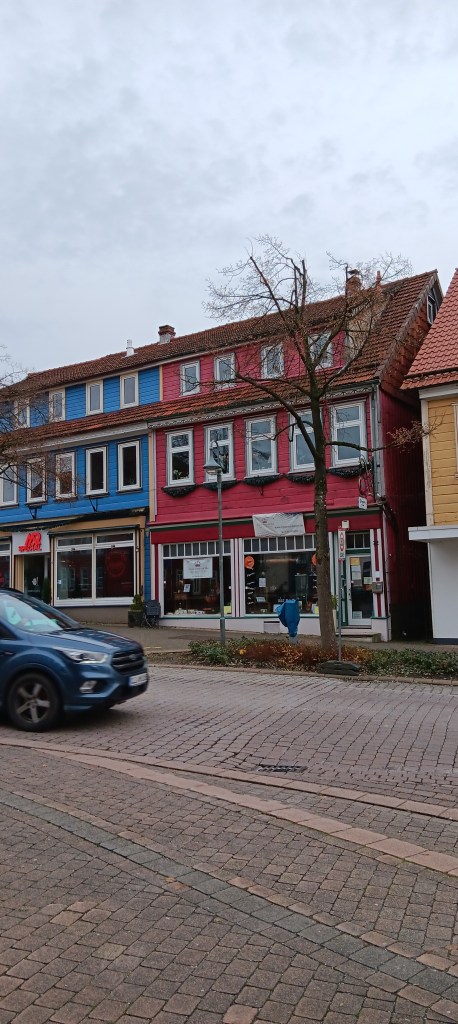
The church is a strange conglomeration of pieces put together in a confusing design. Why such small windows, and can you figure out where each floor starts and ends?
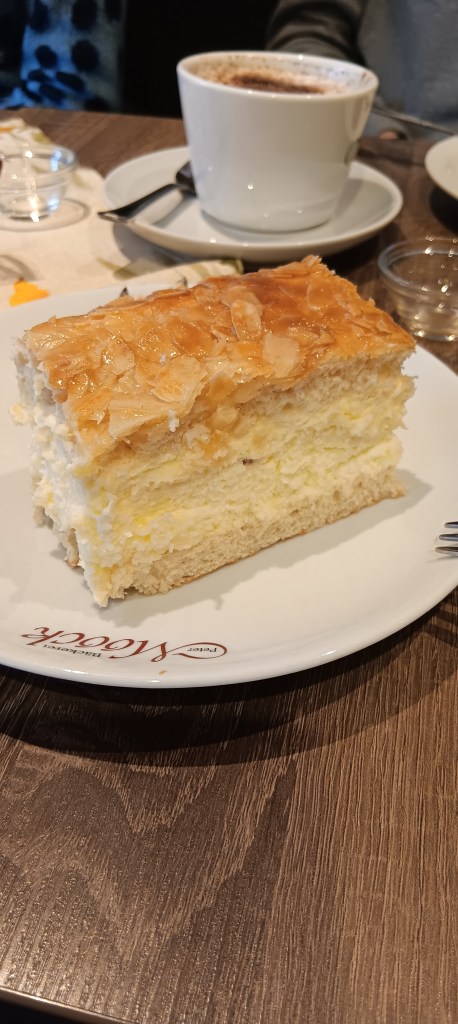
But there was no confusion in the cafe. Such beautiful displays of cakes, biscuits and breads. I chose bee cake, thinking I’d not had it before. Well, yes and no. At home, local bakeries will sometimes offer bee-stings; a family favorite. But they are in a bread-like bun. This German bee cake has the same contents, but with a light crumbled base instead of bun. I am ruined forever!
On the drive back to Braunschweig, swathes of reds and golds cover the forest, as autumn sweeps through. Carefully stacked of logs and firewood lie in wait for owners to retrieve them, as has been done here for centuries.
This is a truly beautiful place, inside and out.
 Stories for you - Enjoy!