The fens of Lincolnshire were part of my ancestral quest on the Great OE; to see the landscape is to understand a little more of the story.
With no sun peeping through the day’s weather forecast, taking a train ride through the countryside seemed a sensible solution to the problem of exploration.
But first the taxi. Thank goodness the buses were delayed, and no Uber available, for without those issues I would not have met my first Egyptian! Our conversation was lively, ranging from eastern politics to travel, hopes to dreams, weather (of course; this is England after all) and so much more. He was tickled to hear acknowledgement of my centuries-old Syrian connections. How few folk today know where their ancestors came from, or about the great migrations of times past.
I wonder if knowing where the ancestors come from may just temper some folks views?
In the taxi our conversational foray into heritage led to discussion about racism. The young man’s experiences suggest that the further north he travels in the UK, the less inclusive the white population can be. Ironically, I’ve heard similar experiences from the Southern Hemisphere, but in mirror image; the further south, the less empathetic. Could it be that polarization is a thing?
I was disappointed to reach the train station; there was so much more to discuss.
North of Cambridge, the train rails wind gently through acres of solar panels under-grazed by sheep. Gradually the soil deepens, from the over-used poorly textured grey/tan, to more friable healthier-looking versions. The area around Spalding, an ancestral foothold, is basically flat, with deep rich black soil, so moist that the farm machinery on view were fitted with wider mud tyres, to prevent getting stuck.
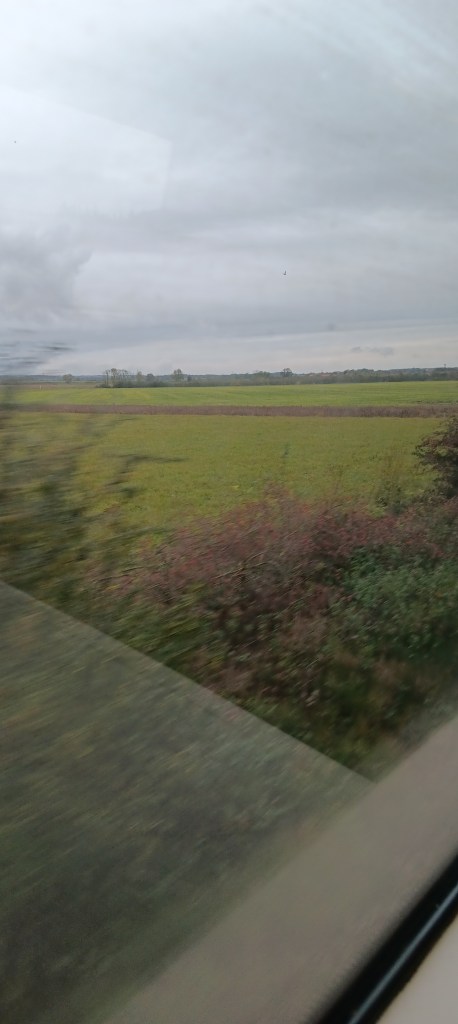
These fens were originally wetlands; thousands of acres destroyed for food production centuries ago. Wetlands are terrific carbon sinks, helping to sequester the bad stuff which humans contribute to climate change. From the train I saw no restoration/regeneration work; maybe it’s happening away from railway lines? Fingers crossed.
There is a noticeable lack of stock, other than a few sheep behind temporary fencing, possibly because heavier animals like cattle would cause dreadful pugging. Acres stretch away towards the horizon, with individual areas identified only through a change in crop, or some physical feature like a drain, rail or road providing a natural border.

Waving at me from a creek border were local plants whose siblings were taken out to New Zealand by UK immigrants nearly two centuries ago. Whilst useful in the UK, these found plant heaven in their new home, and with no natural controls they spread rapidly, shoving aside the native flora. We continue to battle blackberry, hawthorn, barberry, dock, willow, and more.
At Lincoln I changed trains, having achieved my goal for the day. On the second train, a lady sitting beside me turned out to be a retired climate activist, very concerned about some of her colleagues who had been arrested in London that morning. Turning from that, she spoke of other work, expressing pride in how another climate group had planted seven hundred trees in the area we were going through. Though nowhere near enough, every tree helps. I suggested she find, on YouTube, the video of the man who goes out into the wastelands to plant one tree, every single day. He’s been doing it for over thirty years, and the results… well, go and find it for yourself, but watch out for tigers!
Some trains include tabled seating, meaning four people can enjoy conversation as they travel. I happened to be seated so as to be able to see one of just such a group. He was telling the story of finding his lecturer’s phone on the wall of an outdoor site, and idly punching in 1234 as the pin. He was gobsmacked when it worked! The phone was logged in to the university’s internet, so he downloaded an hour-.long porn movie, thinking it a great prank, before replacing the phone on the wall. Unfortunately for the lecturer, the university monitors downloads, and the poor guy had some explaining to do.
The prankster was early twenties, clean-shaven, with intensely blue eyes. He spoke fast, but also listened well, and from his contributions to the groups conversation, it was clear he had a quick lively brain. Underlining his demeanour lay laughter, giving a sense of being good-natured.
And then he vaped. And again. Vaping is banned on trains, with quite serious ramifications for offenders. He was risking a great deal. For a seemingly-intelligent lad, he was being very stupid. But how to interfere, save him from himself, without conflict?
I waited. Inevitably there came a moment when I was able to catch his eye just as he took a dose. In true motherly fashion, I shook my head slowly, fixing him with my best ‘I wouldn’t do that’ look which is usually reserved for errant preschoolers. He stared, reddened, looked away… then looked back. I shook my head again.
He leaned forward and told his mates. They all found ways to peer round at me! My mouth twitched with contained laughter, as I looked back at them with what I hoped was warm friendly eyes.
And then the most extraordinary thing happened. His friends talked to him seriously about how they wished he would give up vaping; none of them did it. He said he can’t without help. One of the group said you can, but it’s got to come from inside. And so it went; an honest conversation quite outside what I had expected.
Soon he changed the subject to football, and they were quickly laughing again. But he wasn’t vaping.
At Ratcliffe-on-Soar, the eight towers of a coal-fired power station dominate the skyline. The chimney reaches two hundred metres into the sky, with four boilers running at five hundred megawatts, producing power for two million homes. The plant is the eighteenth highest emitter of CO2 in Europe, producing eight to ten million tonnes annually. That’s at least 8 million tonnes to power 2 million homes I.e. 4 tonnes per household! Thank goodness they are closing the plant down in 2025.


With wind power and solar panels replacing such plants at increasing pace, partially due to the work of activists highlighting issues, could it be that the consumer will follow their lead, vote with their feet, and demand that all products are properly green and ethical?
We are in changing times; the small decisions you and I (and folk like us) make today may just save the planet.
 Stories for you - Enjoy!