On a train trip, three middle-aged folk, clearly friends, were discussing their teenage offspring various educational futures. Several options were covered, all involving university, regardless of passions and probable future careers. Shock horror when I suggested there were other pathways! Apparently which university, and the college within it, are important badges of honour which must be achieved.
The examples I offered of successful folk who had never attended university did not make the grade.
With this conversation still lurking fresh, I headed to Cambridge, apparently named for the bridge crossing the river Cam, which used to mark the end of the port, despite being fifty miles inland from the main English coast.
But someone important hadn’t liked all that water. They employed the Dutch, who are experts at such things, to drain the fens, thus removing any ability for larger craft to visit. Today the river Cam is lined with canal boats…


… and enjoyed by walkers, birdlife, and punting tours. Did you spot the cat?
The afternoon I visited the area, I’d done enough walking, and didn’t feel remotely like a swan, which just left punting; taking a tour through the universities college areas.
Of course, getting into a virtually flat boat with seats so low your legs must stick rather inelegantly out in front so as to be between your opposite numbers legs is not the most appealing start. Thank heaven none of us were in mini skirts, or any skirt for that matter.
The puntsman, if that’s the right term, was a history major, and keen to share his pride in Cambridge.
And thus it was I learned, amongst many things, how Henry the 8th left considerable funds to Trinity College. The financial team have used it well, if your measure is purely in economic terms. Trinity not only owns a port, and the land under the O2 arena, but legend has it that you can walk from Trinity all the way to their nemesis, Oxford University, without stepping off Trinity land. But Trinity’s main income, to this very day, comes from investments in arms manufacture and trade.
Some folk on the punt were not enthusiastic about that information, so we moved on.
Cambridge University’s library holds many treasures, including the original English King James translation of the Bible, and the original AA Milne stories. It would be interesting which is more widely read now by the under-50’s; Winnie the Pooh, or the New Testament?
Kings Chapel fills the eye, demanding attention, despite scaffolding hiding part of one side. Solar panels are being installed over the entire roof, at a cost of six million pounds. How lovely to see the old embracing the new.
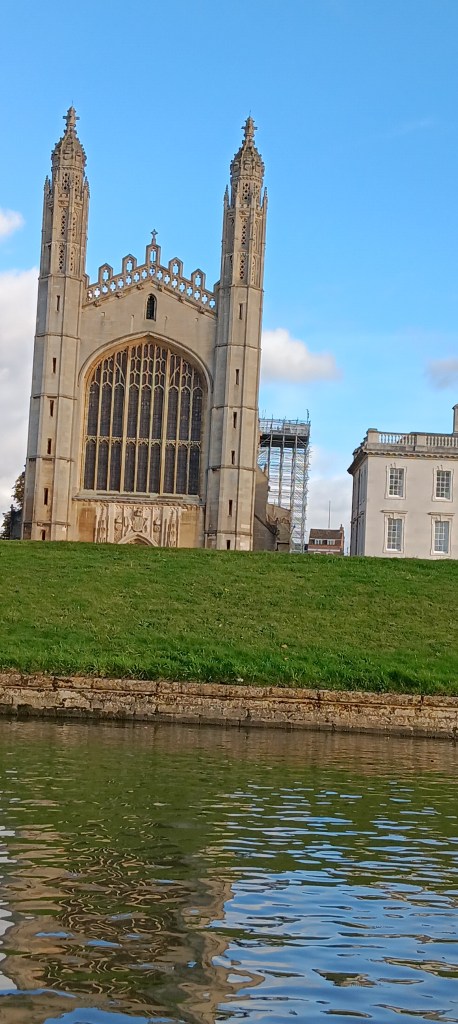
In recent memory, Kings Chapel fell victim to the Night Climbers, an anonymous group of Cambridge University students. This particular club apparently goes back some four hundred years, striking without warning to place random items in impossible spots. In 1963, Cambridge awoke to the astonishing sight of an Austin Seven lashed to the underside of the Bridge of Sighs. No-one admitted to that deed, nor any other like it. In the case of Kings Chapel, a traffic cone appeared on the left hand spire, placed there through an extraordinary feat of free-climbing. An invitation was issued for the cone to be removed, but unsurprisingly no-one came forward. In the end, scaffolders were called. The chapel is so tall, it would take days for the scaffolders to reach that cone. On the morning of day four, how exasperated those in charge must have felt, when they discovered that the cone had magically moved overnight, but not to the ground; it was now on the right-hand spire! Even more impressive, however, is that the identity of the pranksters involved has not come to light, especially given that Cambridge is a place where high achievement is celebrated.
Incidentally, the building in question is a Chapel because it is on private land, whereas the same structure on public property would be a church.
Within the university area, some very special bridges. One is a mathematical timber wonder, whilst another is decorated only on the side visiting dignitaries would historically see. Practical expenditure in action?

Continuing our punting adventure, Turing’s home college surprises with rainbow flags hanging from river-facing windows. Alan Turing was the guy who ‘broke’ the Enigma code, thereby probably saving millions of lives. But he was so much more than that, with his achievements in computing, artificial intelligence, theoretical biology… but he was gay at a time when, no matter your services to humanity, you must be punished. And punished he most certainly was, including prosecution in 1952, and chemical castration. He died of cyanide poisoning not long after. ‘Turings law’ refers to an Act of Parliament which allows for retrospective (and posthumous) pardoning of convictions relating to homosexuality. Thus his college honors his memory with rainbow flags today. And, as an addendum, the reason the Google spiral is rainbow? It’s Steve Jobs expression of admiration for the man that was Alan Turing.
On the opposite side of the river, flaming ivy camouflages the walls of a college which were built after the relevant budget brigade realized that the construction fund was running too low for fancy facades.


But how did Cambridge University come to be in the first place, given that Oxford was already in existence? The answer lies in the social and political prejudice of the era, brought to a head when a boy was executed on the lawn at Oxford. Many students and staff walked away, choosing to form the new university at Cambridge.
Old rivalries remain, no longer expressed in barbaric acts, but in more acceptable forms, notably rowing and the like. Ask any Cambridge alumni and they will tell you Cambridge is the superior university of the two, noting their Nobel prize numbers, and rowing success. Trinity alone has had thirty Nobel prizes, and are proud to count folk like Stephen Hawking in it’s alumni. Certainly the young man gliding us along the river devoutly believes Cambridge is the superior university. I haven’t approached Oxford for a response!
 Stories for you - Enjoy!