Some days are meant to be; days when the lucky charm hidden deep in your pocket really is working it’s magic. This was the case on the day I visited the Eden Project.
I had been planning on strolling through a national garden nearby, but with time to spare, thought I’d pre-book for the next day at Eden. But oh! They were going to be closed for the following three days! Quick change of plans. I had just twenty minutes to catch the train, ten minutes walk away, and I wasn’t yet dressed!
I made it with seconds to spare, only to learn the train was cancelled. Urgent work being done on the line apparently. But joy of joys, a luxury coach to replace it, with a driver using his navman for directions. The originally booked replacement bus had developed a problem, so this poor driver was chucked right in it. He did an amazing job, especially considering the forty sets of eyes riding along with him!
A tiny frail-looking lady with thinning whispy hair sat next to me. She was dressed for town, carefully colour-matched in blue, with a colorful scarf highlighting her discreet makeup. Upon hearing I was from New Zealand, she responded ‘How lovely. I nearly went there once, when I went to California for three weeks.’ Oh well…
On our journey I saw a sign for the Cornwall football golf club. Apparently the rules are the same as for golf but the players kick soccer-sized balls instead of using golfing gear. Sounds fun!
At St Austells a bunch of us waited for our connection to Eden. The advisory information board kindly counted down the minutes, and then, just when it should have said the bus had arrived, gremlins removed our bus route altogether! Eek!
A few questions, and one apologetic bus driver later, we were on our way.
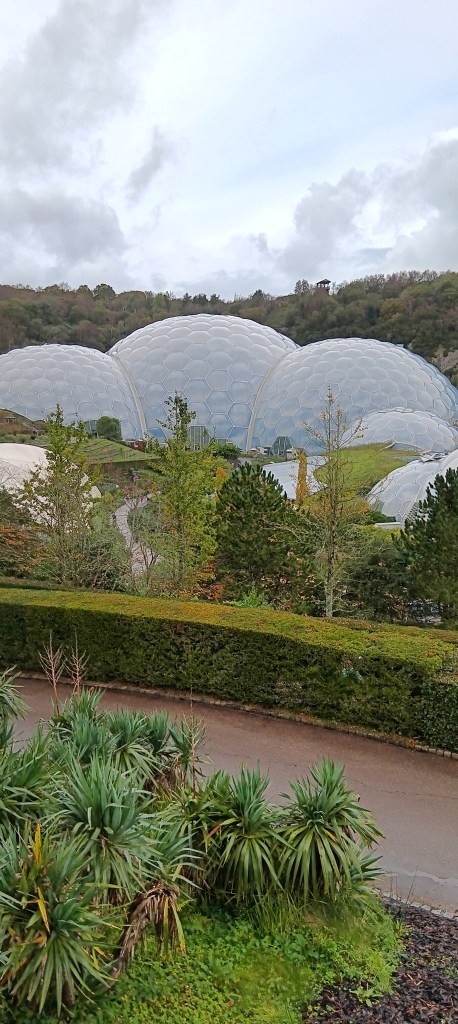
No photos of the Eden Project can truly demonstrate the sheer scale of the site. Even the entranceway is spectacular, with it’s curves, wall gardens, and information boards.

Once you’ve braved the check-in queues and stepped through the magic doors, paths curl enticing away; it’s hard to choose. Do you head straight to the imposing biomes, or tease yourself by winding through various hillside gardens. Whatever you choose, be prepared to spend hours.

A new outside area is being developed to celebrate success in the demilitirisation zone between North and South Korea. The Korean landscape across both countries lost eighty percent of it’s forest in less than sixty years, due to a combination of war and over-use. In response, South Korea implemented a policy of tree planting; over ten billion (!) trees in thirty years. This is one of the world’s largest regeneration projects, with over five thousand species of flora and fauna involved.
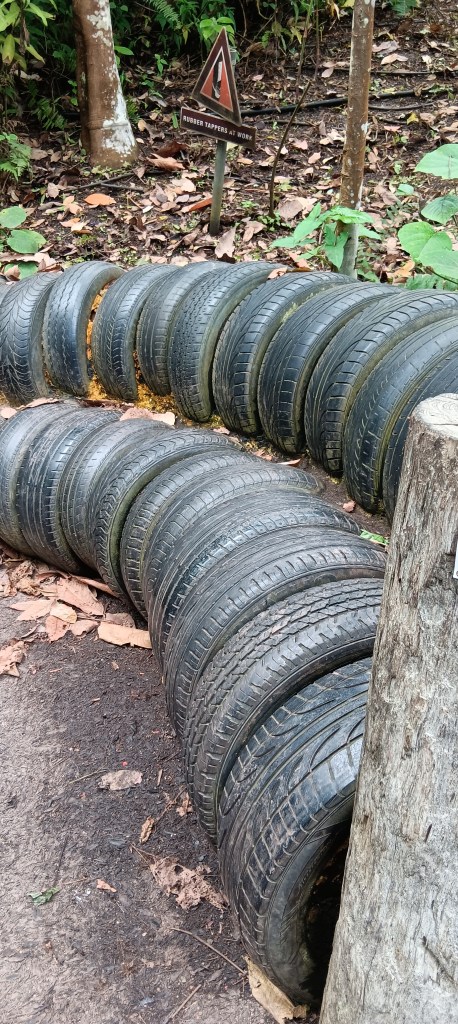
I was surprised that the site promotes soya oil for bio-fuels. But more interestingly, they display eco-friendly ‘Fair rubber’ car tyres made from the white liquid latex milked from under rubber-tree bark.
Another shock: the UK, population under seventy million, uses 1.84 billion tonnes of sugar per year, more than double the wheat consumption.
The bananas we eat (though not me) are nearly all the Cavendish variety, regardless of where they come from. Their DNA is identical, due to how they breed, and therefore the plants are very susceptible to pest and disease attacks. As a result, they have to be treated with a cocktail of chemicals which is particularly unhealthy for the workers. Perhaps this is another case of checking out what’s involved in getting food to our shelves, and then making good choices?
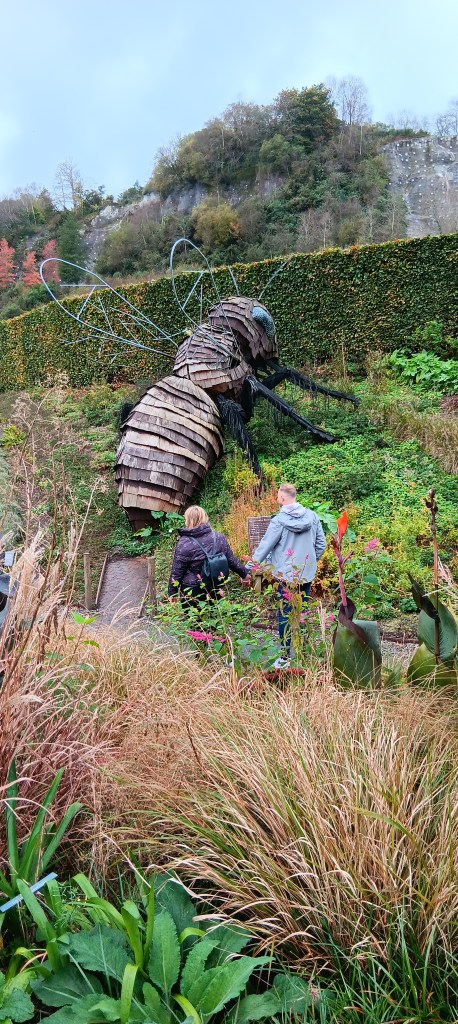
The outside gardens at Eden are dotted with carefully placed sculptures, including a rather exciting bee:
And this contemplative lady:

There’s danger in such an absorbing site of not leaving enough time for every section, especially when you want to consider what you are reading, whether it be fact or…. well, you decide…

Drawing closer to the biomes, their true size began to reveal itself. Check out the door:
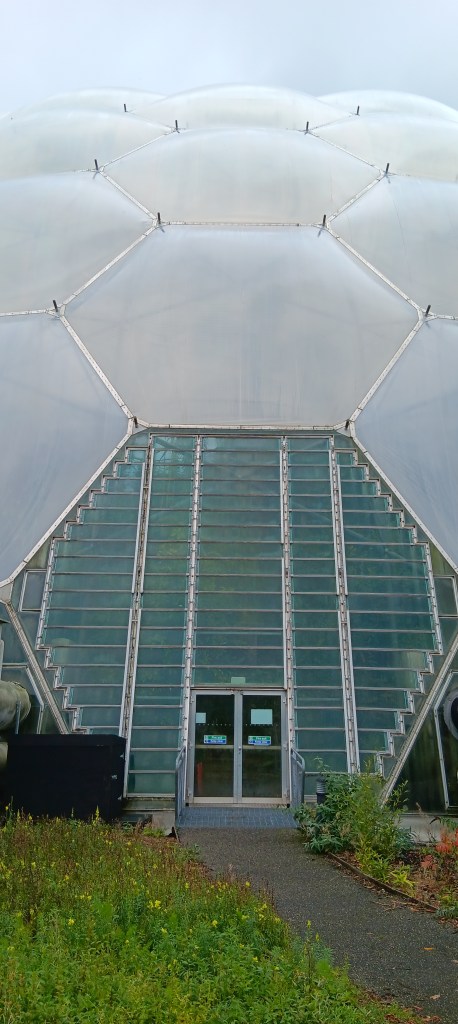
Eventually I got to the main event, just as a curtain of heavy rain arrived; several unfortunate folk who had gone to explore indoors first gazed mournfully at the sky, then retired to the cafe.
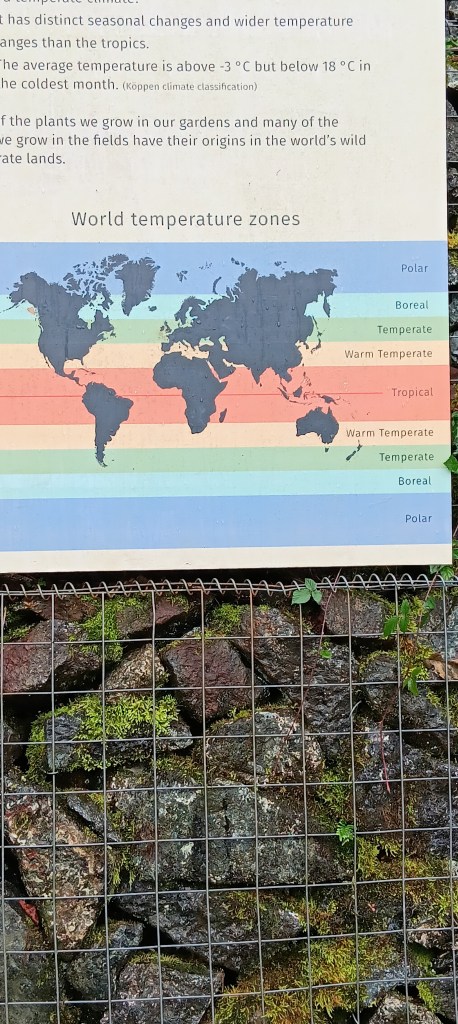
As to those immense biomes; what an adventure. I turned left, into steamy rainforest so muggy there are cooling-off rooms for anyone becoming overcome. The path winds through Asia, country by country, but without the snakes and other fauna. Trees reach their full height, and there’s fruit and flowers unlike anything I’d ever seen before. In one spot, bamboo stems over one hundred millimeters across, so strong and straight, yet hollow to tap.


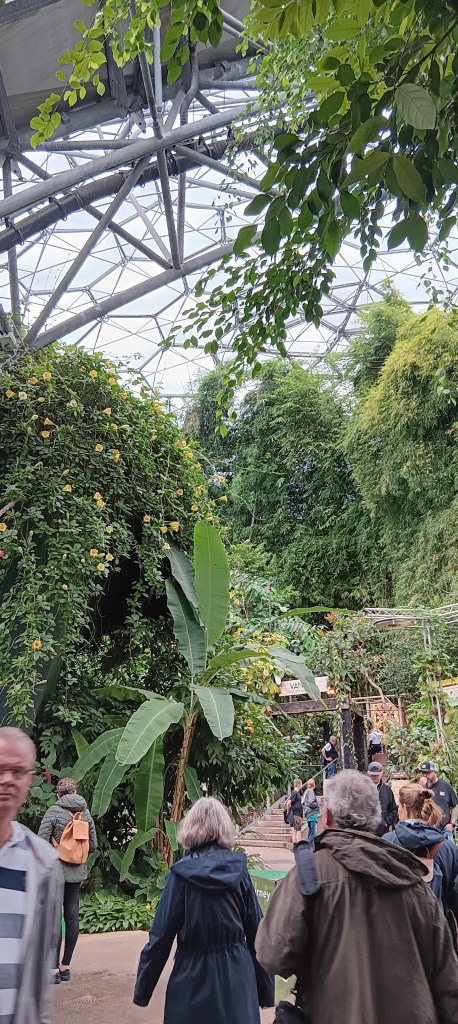
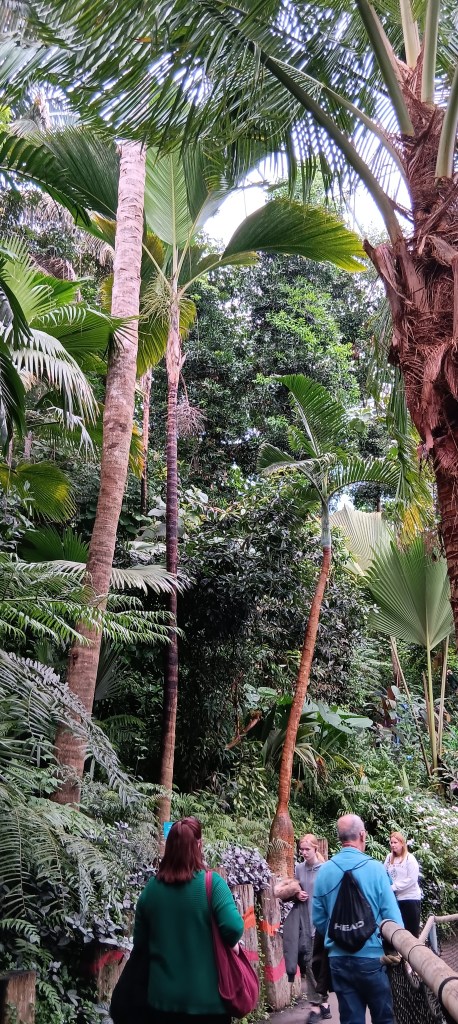
One aspect of the rainforest area which I hadn’t anticipated was immigrant families showing their UK-born children the plants from the parent’s childhood. There was a Dad explaining how the rice wasn’t ready yet, and an uncle demonstrating how to tell if a fruit was ripe. Several of us unashamedly moved closer to hear these insights into lives we know so little about. How fabulous for these families to have a place where they can connect their children with ancestral knowledge.


And then, an elderly man in a wheelchair parked in one spot, gazing at a corner of plants, with gentle tears. His daughter (?) sat quietly beside him, with a hand resting on his arm. What (or who) was he remembering? I felt like an intruder, and moved on.
High in the canopy, rope bridges. The youngsters crossing just in front of me couldn’t suppress the urge to bounce and sway…
Then came the spice trail. Who knew mace and nutmeg come from the same the plant, coffee beans grow inside coffee red cherries on four feet high bushes, and black pepper is a vine?
Leaving the rainforest, heavenly scents lured me into the Mediterranean section. Brightly coloured flowers lace across warm rocks, and small children found stone-hopping challenges.
Further on, South African fynbos, mostly proteas, aloes, and plants with thin wiry-looking leaves. The area is quite open, with plants social distancing.
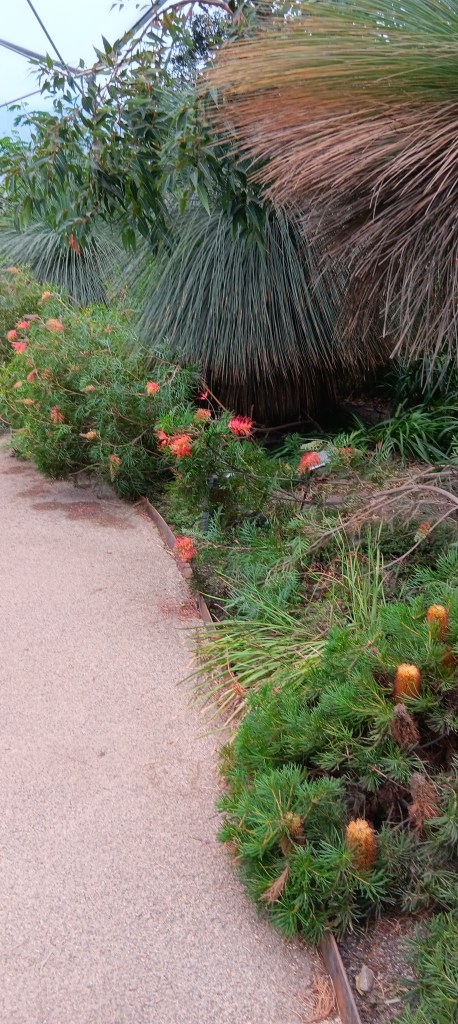


There’s no mistaking the smells of Australia in their section; eucalyptus include the beautiful Silver Princess.

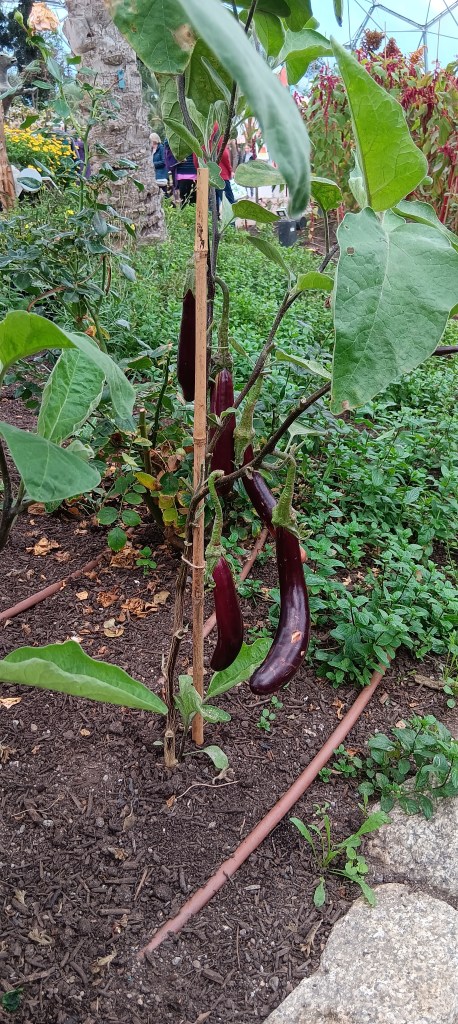
Edibles are not just confined to the kitchen gardens and forests. This Italian pepper ‘Violetta Lunga’ was near the Mediterranean section:
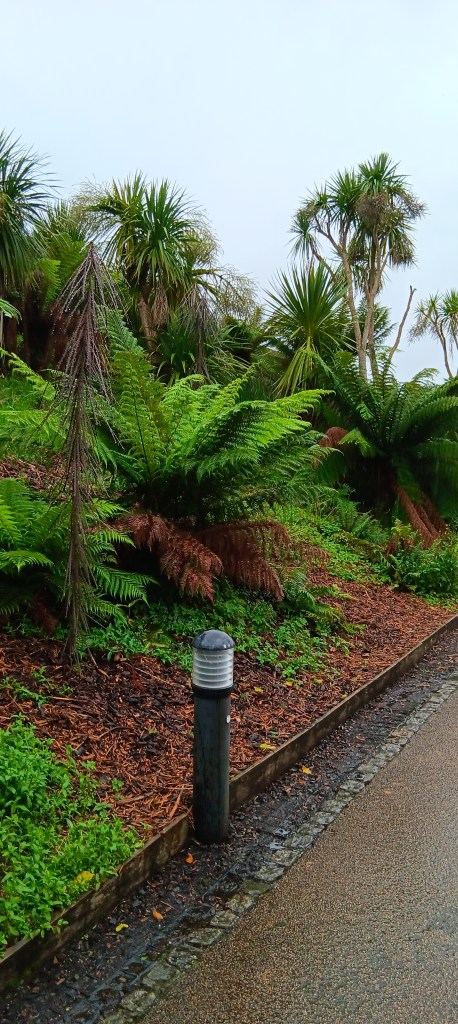
Leaving the bionomes, I trundle up towards the Visitor Centre, thinking my day was done. But lo! Tucked into a section of path everyone would take at some point during their day was the incredibly beautiful New Zealand section, with the moa-adapted lancewoods, sweet-smelling kanukas, wavy-leafed cabbage trees, gentle ferns, and so much more! What joy! And then disappointment. Not a single plant had an identification label, no stories burst forth and the area was devoid of Iwi blessing. To cap it all off, there was nothing to say this was the New Zealand garden. I felt robbed.

The bus stop was quite a climb in the rain, but with an hour until the bus was due, I had time enough for a hot drink or two from my trusty flask. The bus for another route came along just as I’d downed the first cup. ‘Hop aboard’ the cheerful driver said. ‘After I’ve dropped this lot off I’m heading straight to St Austells.’
And so it was that I was back at St Austells catching the service to my accommodation at precisely the time the ‘correct’ bus would have been leaving the Eden Project. Surely that charm in my pocket had worked it’s magic again.
 Stories for you - Enjoy!