According to most maps, the Manchester to Buxton train route passes through towns and villages which dotted between more rural areas, but in truth urban sprawl has absorbed old boundaries, meaning these seperate identities now touch hands. There’s no rural to be seen until just before Middlewood, and the first real farms are even further on, just before Disley. (Check it out on a map). Such a relief to see wide open spaces, sheep grazing, and a distinct lack of scuttling humans.
At Mills Newton, an older guy using a mobility scooter was having difficulty getting off the train. A group of travellers assisted, but assured him it was only because he was wearing the right football supporters hat; any other and they would have just thrown him off!
The further the train got from Manchester, the better tended the stations, with fresh paint, gardens full of flowers, and, best of all, no litter.
And then came the first glimpse of canal boats, near Furness Vale! Some were double-parked in layby areas, (Yes, I know the correct term is ‘moored,’ but there’s no fun in that) and several others were clearly permanent homes, with extensive gardens alongside. The range of styles, shapes and decor would make an entire book. There were the pristine freshly-dressed ladies showing off their elegant lines, through to an old wizened grey tub with grass tufts. She lay low in the water, too tired to bother. Sagging lines wrinkled her deck, and yet her site under a canopy of autumnal trees dappled her into beauty.
The view from the train changed, morphing into rolling hills, green flats, trees spreading along fencelines, and areas of forest showing off the gentle hues of death. Leaves turning gold, red and brown in preparation for being blown into tomorrows compost.
At Chapel-en-le-frith station, a plaque commemorates two men who died when a runaway freight train collided with a goods train. Both men stayed on their trains, with one in particular working right up to the end, despite severe heat, trying in vain to stop prevent the inevitable collision. He was awarded a heroism award posthumously.
Buxton is the end of the line, but what a place to end up in! Of course, finding one’s accommodation is always first priority (after the toilet), so I stood outside the station googling for a map location and directions. It wasn’t until I looked up that I saw it; the place I was looking for was right in front of me! Oh, well.
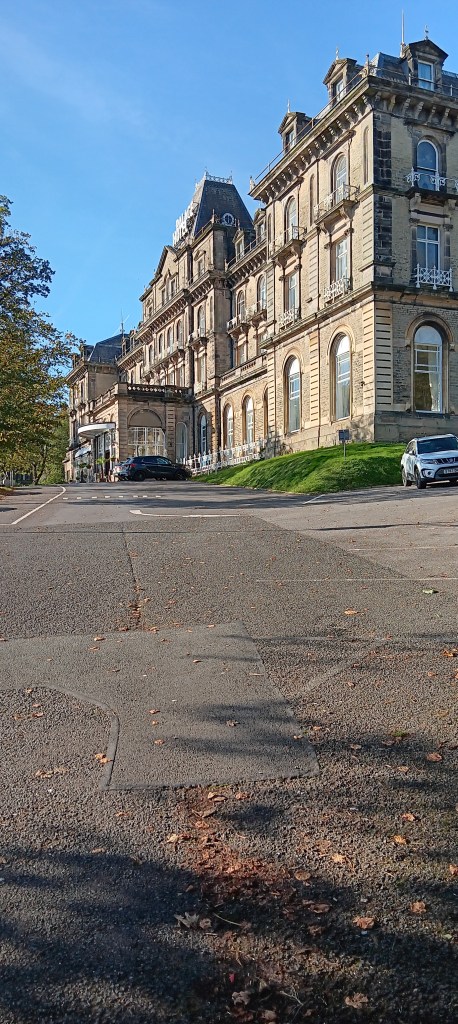
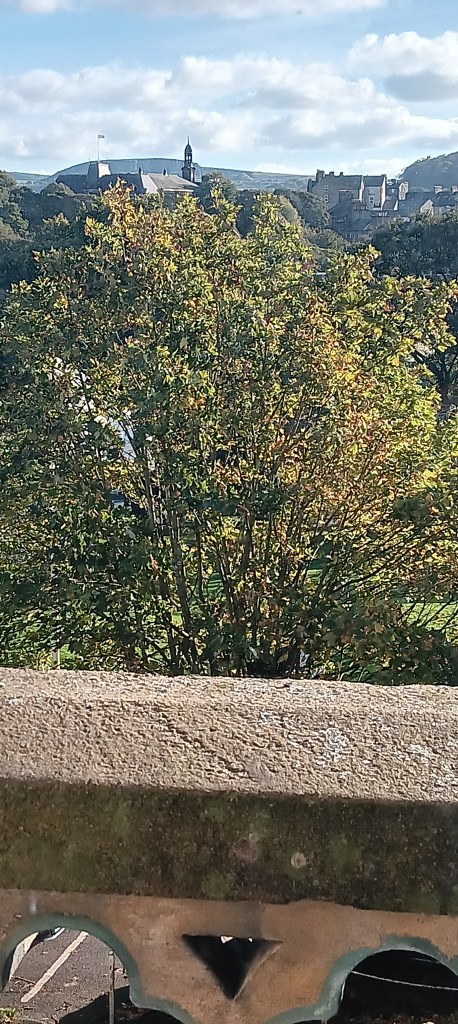
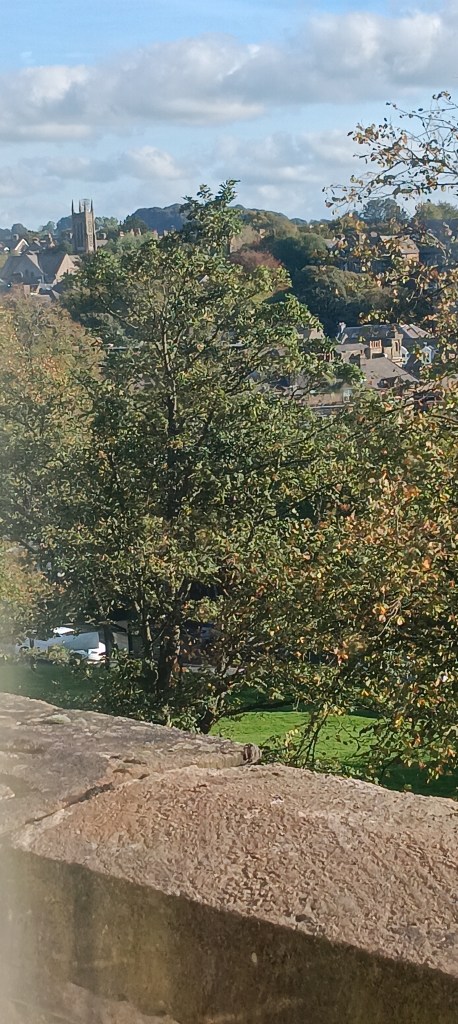
And what a place, or rather, palace! My room on the first floor looked over the balcony, right across the valley. Church spires pierce the treetop canopy; it’s hard to believe there’s a large town spread about underneath.
The Pavillion Gardens tea rooms sell a pastie of curried cauliflower, chickpeas and onion which should have a climate change warning (for the tastebuds) on them.
Entry to the conservatory there is a hotch potch, and if the visitor doesn’t persevere they will most likely miss the main show. Perhaps this is a useful tool for restricting foot traffic?
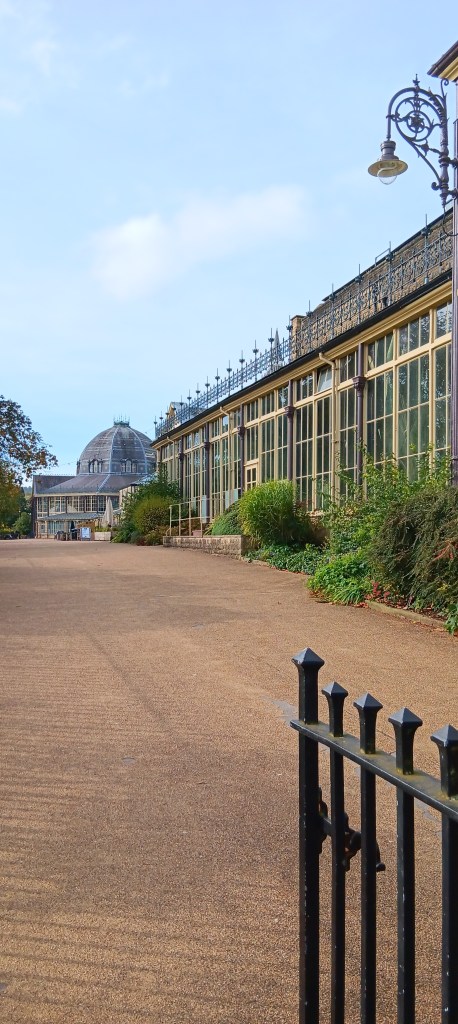
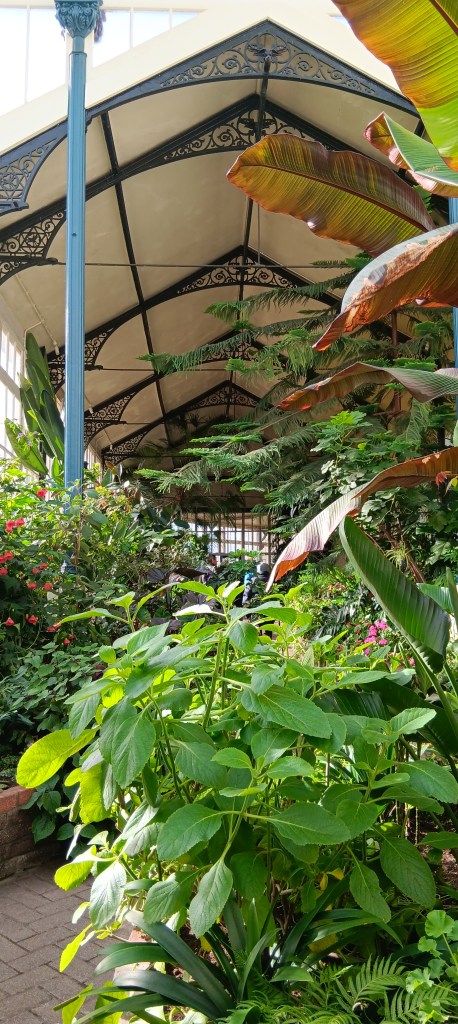
In the conservatory a lively gent was telling relatives about researching their shared ancestry. There was great excitement when he explained one such ancestor was, according to the census, a painter. He let the excitement bubble a little, before knocking it dead with the further explanation that the painter was in fact a railway carriage painter.
Out in the gardens, families playing, children threatening to stumble into waterways, couples walking their dogs, and friends ambling the afternoon away.

A big man on a new maroon mobility scooter sat watching the world go by. He has a room at a retirement home nearby, but they let him out each day. His speech is slow, but he gets there.
Years ago, Doctors wanted to amputate his left leg, so he could be mobile again. He turned down their kind offer on the grounds he was quite attached to it, even if it wasn’t listening. Then a couple of years later the Doctor’s wanted to take the other leg. He told them they were just being ‘bloody cheeky’ now.
When he discovered where I was staying, he said he had been the night porter there. The pay was very low, despite the elite patronage. To compensate, he would take home a box of whiskey, selling the bottles to make his pay up to what was fair. He said he never went higher than fair. He never got caught either!
An energetically wired black and white collie brought me a stick, dropping it a few feet away. The collie then lay low, coiled for action, ready for my move. He sported black freckles through the white bits of coat, perhaps suggesting some naughtiness in his ancestry.
Every few minutes, that collie would pick up the stick, to drop it closer. Eventually the snobbery stick lay between my feet. How can such expectation be ignored? Of course, one throw wasn’t enough for that dear collie. His sheer delight was obvious in the alacrity, and concentration.
When it was time to end the game, I placed the stick on the park bench, beside the dog’s owner. She, in her purple hair and expensive puffer jacket, recoiled, saying loudly ‘ I don’t want it’. She then hit speed dial on her phone; both me and the collie were dismissed. The dog sat by the park bench, chin on the seat, gazing at the stick. I wonder how much fun her dogs have when there’s no strangers around?
In the park, a Celtic mound from c3000bc. It is now smaller than originally, due to an 1870 garden remodel, but the spiral is original. The mound has been reduced to about five feet tall. The spiral statue on top is pre 1700.

A short walk from the gardens is a lightly-treed hill roll-calling a memorial; the teddy’s message, and the inscriptions on the crosses especially poignant.


And at the bottom, St Ann’s well, a thermally-steady 27-degree mineral spring, sacred to Celts thousands of years ago as a healing place with special powers. In 70ad the Roman’s arrived, building the baths that remain today.


Buxton is a divided town, but happily so. There’s the lower town, with it’s cobbles and lanes, and the higher town set around tar-seal and proper car parking. I was lured down the cobblestone, between village shops, past outdoor Cafe seating and old steel lamp posts suspending baskets overflowing with colour, by a pied piper… actually a flutist playing gentle operatic music. His notes floated along the street, sometimes hanging in the air, and sometimes rippling forth.

But Buxton had another surprise. Not only was Joan Collins giving a talk at the Opera House, but author Andrew Lownie was presenting a session on the lives and loves of the Mountbattens. I chose the latter, and what a night it was! Their story is worthy of any film, with an amazing mix of duty, wealth, infidelity-driven naughtiness (that’s the politest term I could find), drama, murder and extraordinary benevolence.
Buxton isn’t just the end of the train line, but is truly a destination worth visiting.
 Stories for you - Enjoy!