Decisions; every day, everywhere. Some wise, others less so, but sometimes they are forced upon us…
Mallow racecourse, Co Cork, 1983. With just three minutes of fuel left, the captain of a gulf-stream jet put down on the only piece of level ground he could see. And there it sat. Jet aircraft don’t work well on racecourse surfaces. The insurance company weren’t ready to write it off though. Over the next six weeks, for a mere three million dollars, a temporary runway was built, and away the jet went.
But there’s an encore in the wind. The captain had become a celebrity in Mallow during his unexpected visit, and he returned, sans plane, many times in the ensuing years. He became so fond of the place, his ashes are to be scattered in Mallow, at his request. And earlier this year the jet was located, enabling progress in a plan to bring it back to Mallow as a permanent display. However, this time it will arrive by more conventional means.
Like many areas, the way things are done changes with technology and fashion. Thatched rooves are less common in Southern Ireland nowadays, but it’s still well-known that cats like to sneak up onto sheltered spots to bask in the thatch warmth. When the inevitable rain arrives, the cats take the most efficiently speedy route possible to prevent getting wet, jumping to safety; hence the saying ‘it’s raining cats’… and dogs got in the act because it sounds better!
Another saying for which you can still see evidence today is ‘daylight robbery.’ In 1799 the government brought in a window tax resulting in building owners quickly bricking up windows to avoid the tax, but losing light in the process. In the Irish cottage, with no windows letting in light, a solution was found by building half doors, enabling children and animals to be kept in (or out, depending on preference,) yet still allowing light in by swinging the top half of the door open.
Responding with good decision-making will see further adaptations to external forces in the years to come. The Republic of Ireland is potentially facing an unexpected problem from climate change. Due to the way the sea currents work, while most of the planet heats, they may endure another ice age.
But for now, coach loads of tourists travel the beaten path to the Cliffs of Moher, where even the buskers have to protect themselves from the sea.

The design of the commercial and tourist information area deserves a medal:

And the cliffs (for scale, enlarge the photos… in the first there are cattle grazing on the flattest area, and in the second there are Walkers atop the nearest cliff)


With countless coaches daily, it was inevitable that a local would find a way to take advantage. A lovely grey roan horse called Johnny, whose paddock happens to be next to a narrow stretch of road, figured out that if he stood leaning over the stone wall looking very cute, tour guides would stop to feed him an apple, impressing the tourists watching. But of course, too much of a good thing makes you ill, and Johnny was not immune to the trials of over indulgence. There is now a polite notice on the fence asking tour guides not to feed Johnny. But he remains hopeful, with outstretched neck and begging eyes as each bus crawls on by.
Tour buses usually work to a tight schedule, but there are exceptions. In what felt like the middle of nowhere, on a road lined with stone walls, the bus stopped and the engine switched off. A quiet announcement just said we could be a few minutes. We watched as mourners parked their cars in a paddock before walking out onto the road in front of us. Congregating behind pallbearers, the large crowd walked down the road, turning off up a laneway to a plateau’d graveyard. The light oak casket, adorned with flowers, and carried by dark-suited men, made it’s way slowly up the slope. Many folk carried floral tributes, and all appeared quiet. Not a single driver waiting to go past started their vehicle until the last mourner was off the road, and not a single photo was taken from the tourist coach.
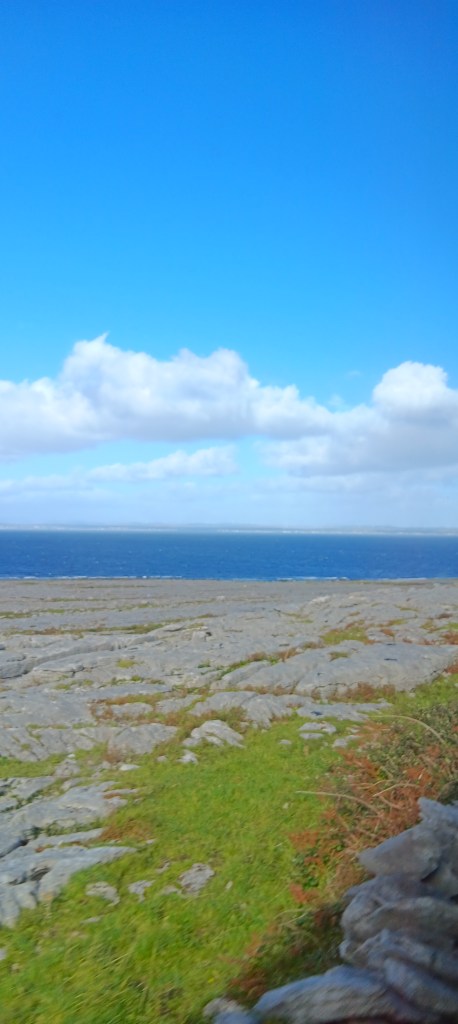
This Ireland casts spells: take the music of Enya, add in views of drystone walls, thatched cottages, a leprechaun castle (otherwise known as a dipping well), the grey slab rock hills of the Burren (splattered with gold-tinged green) and a gently white-capped Atlantic Ocean kissing the soft-grey rock beaches… this is the mystical Ireland which mellows the soul.
But then, Corcomroe Abbey. Apparently King Conor na Siudane Ua Briain commissioned the Abbey c1200. No expense spared, the building became recognized as a masterpiece. The King then had the five masons responsible executed, to prevent anything as beautiful being built elsewhere. The mason’s bodies are said to be buried under the now derelict building.
And speaking of outrageous behaviour, a 40-something ‘gentleman’ on the coach clearly couldn’t wait for the next town, persuading the driver to pull over. The gent then alighted, and soon a golden fountain was seen watering the grass. Did he try to hide behind the line of trees available, or even find a discreet corner away from innocent eyes? No, not a chance.
Some decisions are wise, some urgent, and some just plain dreadful.
 Stories for you - Enjoy!